The Sun
The Sun is a yellow dwarf star (G2V), about 4.6 billion years old, and the dominant gravitational force in the Solar System. It has a diameter of roughly 1.4 million kilometers and contains around 99.8% of the Solar System’s mass. Nuclear fusion in its core converts hydrogen into helium, producing energy that warms the planets. Above the core lie the radiative and convective zones, followed by the visible photosphere (~5,500 °C), the chromosphere, and the much hotter corona (~2 million °C).
Source: science.nasa.gov
APODs including "The Sun"
Massive Stars in NGC 6357
05/02/2016
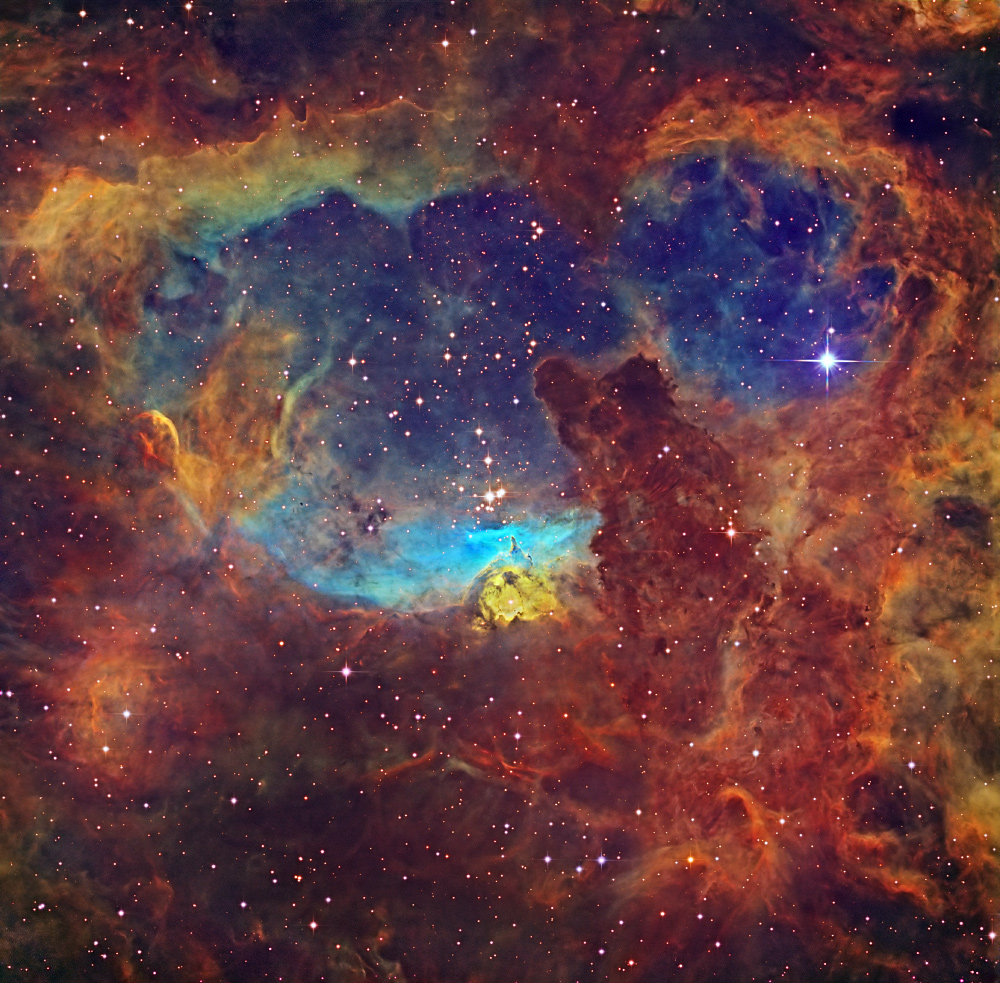
Massive stars lie within NGC 6357, an expansive emission nebula complex some 6,500 light-years away toward the tail of the constellation Scorpius. In fact, positioned near center in this ground-based close-up of NGC 6357, star cluster Pismis 24 includes some of the most massive stars known in the galaxy, stars with nearly 100 times the mass of the Sun. The nebula's bright central region also contains dusty pillars of molecular gas, likely hiding massive protostars from the prying eyes of optical instruments. Intricate shapes in the nebula are carved as interstellar winds and energetic radiation from the young and newly forming massive stars clear out the natal gas and dust and power the nebular glow. Enhancing the nebula's cavernous appearance, narrowband image data was included in this composite color image in a Hubble palette scheme. Emission from sulfur, hydrogen, and oxygen atoms is shown in red green and blue hues. The alluring telescopic view spans about 50 light-years at the estimated distance of NGC 6357.