The Sun
The Sun is a yellow dwarf star (G2V), about 4.6 billion years old, and the dominant gravitational force in the Solar System. It has a diameter of roughly 1.4 million kilometers and contains around 99.8% of the Solar System’s mass. Nuclear fusion in its core converts hydrogen into helium, producing energy that warms the planets. Above the core lie the radiative and convective zones, followed by the visible photosphere (~5,500 °C), the chromosphere, and the much hotter corona (~2 million °C).
Source: science.nasa.gov
APODs including "The Sun"
Neon Saturn
13/03/2016
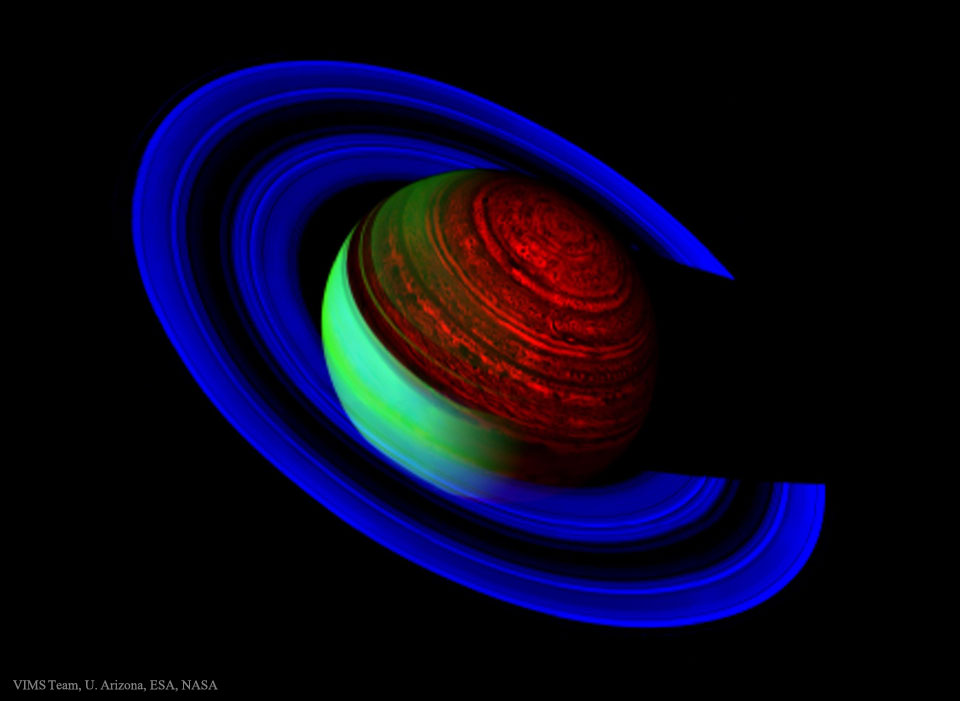
If seen in the right light, Saturn glows like a neon sign. Although Saturn has comparatively little of the element neon, a composite image false-colored in three bands of infrared light highlights features of the giant ringed planet like a glowing sign. At the most blue band of the infrared light featured, false-colored blue in the above image, Saturn itself appears dark but Saturn's thin rings brightly reflect light from our Sun. Conversely, Saturn's B ring is so thick that little reflected light makes it through, creating a dark band between Saturn's A and C rings. At the most red band of the infrared, false-colored red above, Saturn emits a surprisingly detailed thermal glow, indicating planet-wide bands, huge hurricane-like storms, and a strange hexagon-shaped cloud system around the North Pole. In the middle infrared band, false-colored green, the sunlit side of Saturn's atmosphere reflects brightly. The above image was obtained in 2007 by the robotic Cassini spacecraft orbiting about 1.6 million kilometers out from Saturn. Follow APOD on: Facebook, Google Plus, Twitter, or Instagram