The Sun
The Sun is a yellow dwarf star (G2V), about 4.6 billion years old, and the dominant gravitational force in the Solar System. It has a diameter of roughly 1.4 million kilometers and contains around 99.8% of the Solar System’s mass. Nuclear fusion in its core converts hydrogen into helium, producing energy that warms the planets. Above the core lie the radiative and convective zones, followed by the visible photosphere (~5,500 °C), the chromosphere, and the much hotter corona (~2 million °C).
Source: science.nasa.gov
APODs including "The Sun"
Auroras and the Magnetosphere of Jupiter
06/04/2016
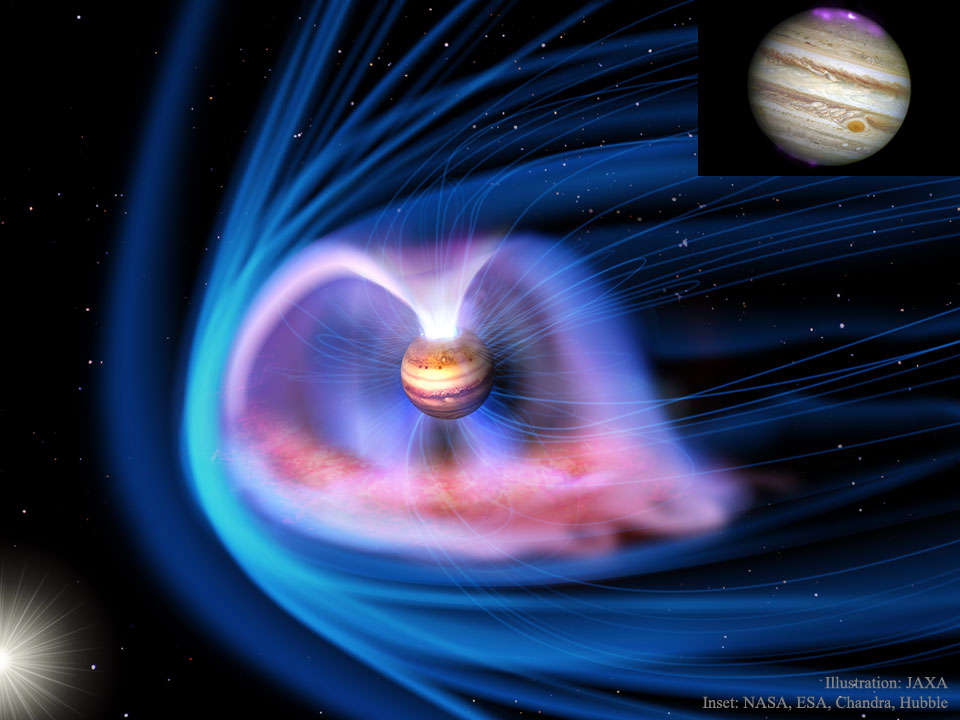
Jupiter has auroras. Like near the Earth, the magnetic field of our Solar System's largest planet compresses when impacted by a gust of charged particles from the Sun. This magnetic compression funnels charged particles towards Jupiter's poles and down into the atmosphere. There, electrons are temporarily excited or knocked away from atmospheric gases, after which, when de-exciting or recombining with atmospheric ions, auroral light is emitted. The featured illustration portrays the magnificent magnetosphere around Jupiter in action. In the inset image released last month, the Earth-orbiting Chandra X-ray Observatory shows unexpectedly powerful X-ray light emitted by Jovian auroras, depicted in false-colored purple. That Chandra inset is superposed over an optical image taken at a different time by the Hubble Space Telescope. This aurora on Jupiter was seen in October 2011, several days after the Sun emitted a powerful Coronal Mass Ejection (CME).