The Sun
The Sun is a yellow dwarf star (G2V), about 4.6 billion years old, and the dominant gravitational force in the Solar System. It has a diameter of roughly 1.4 million kilometers and contains around 99.8% of the Solar System’s mass. Nuclear fusion in its core converts hydrogen into helium, producing energy that warms the planets. Above the core lie the radiative and convective zones, followed by the visible photosphere (~5,500 °C), the chromosphere, and the much hotter corona (~2 million °C).
Source: science.nasa.gov
APODs including "The Sun"
Full Venus and Crescent Moon Rise
14/04/2016
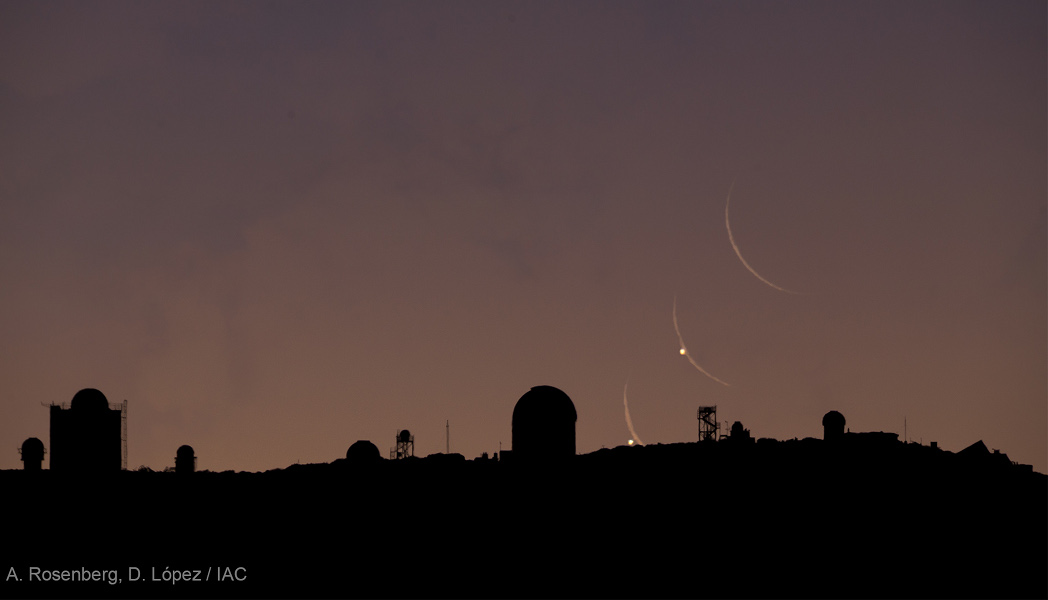
Inner planet Venus and a thin crescent Moon are never found far from the Sun in planet Earth's skies. Taken near dawn on April 6, this timelapse composite shows them both rising just before the Sun. The mountaintop Teide Observatory domes on the fortunate island of Tenerife appear in silhouette against the twilight. In fact, the series of telephoto exposures follows the occultation of Venus by the Moon in three frames. Far from Earth in its orbit and in a nearly full phase, Venus was 96 percent illuminated. Near perigee or closest approach to Earth, the Moon's slender crescent represents about 2 percent of the lunar disk in sunlight. Seen in the first two exposures, the brilliant morning star only vanishes in the third as it winks out behind the bright lunar limb. Five minutes of the dramatic occultation at dawn is compressed into 15 seconds in this timelapse video (vimeo).