The Sun
The Sun is a yellow dwarf star (G2V), about 4.6 billion years old, and the dominant gravitational force in the Solar System. It has a diameter of roughly 1.4 million kilometers and contains around 99.8% of the Solar System’s mass. Nuclear fusion in its core converts hydrogen into helium, producing energy that warms the planets. Above the core lie the radiative and convective zones, followed by the visible photosphere (~5,500 °C), the chromosphere, and the much hotter corona (~2 million °C).
Source: science.nasa.gov
APODs including "The Sun"
Milky Way and Planets Near Opposition
21/05/2016
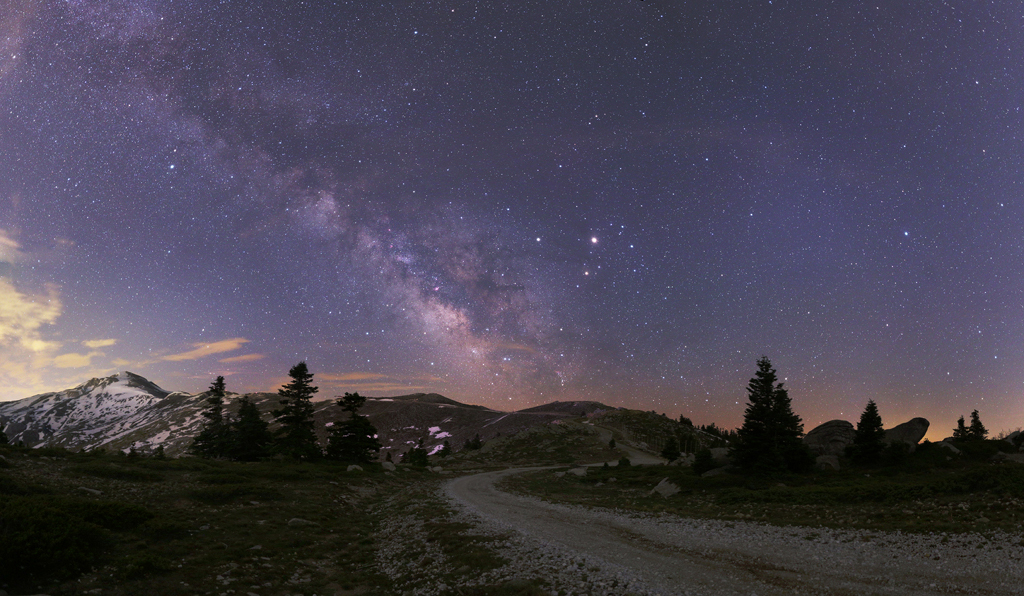
In this early May night skyscape, a mountain road near Bursa, Turkey seems to lead toward bright planets Mars and Saturn and the center of our Milky Way Galaxy, a direction nearly opposite the Sun in planet Earth's sky. The brightest celestial beacon on the scene, Mars, reaches its opposition tonight and Saturn in early June. Both will remain nearly opposite the Sun, up all night and close to Earth for the coming weeks, so the time is right for good telescopic viewing. Mars and Saturn form the tight celestial triangle with red giant star Antares just right of the Milky Way's central bulge. But tonight the Moon is also at opposition. Easy to see near bright Mars and Saturn, the Full Moon's light will wash out the central Milky Way's fainter starlight though, even in dark mountain skies. Participate: Take an Aesthetics & Astronomy Survey