The Sun
The Sun is a yellow dwarf star (G2V), about 4.6 billion years old, and the dominant gravitational force in the Solar System. It has a diameter of roughly 1.4 million kilometers and contains around 99.8% of the Solar System’s mass. Nuclear fusion in its core converts hydrogen into helium, producing energy that warms the planets. Above the core lie the radiative and convective zones, followed by the visible photosphere (~5,500 °C), the chromosphere, and the much hotter corona (~2 million °C).
Source: science.nasa.gov
APODs including "The Sun"
Comet PanSTARRS in the Southern Fish
17/06/2016
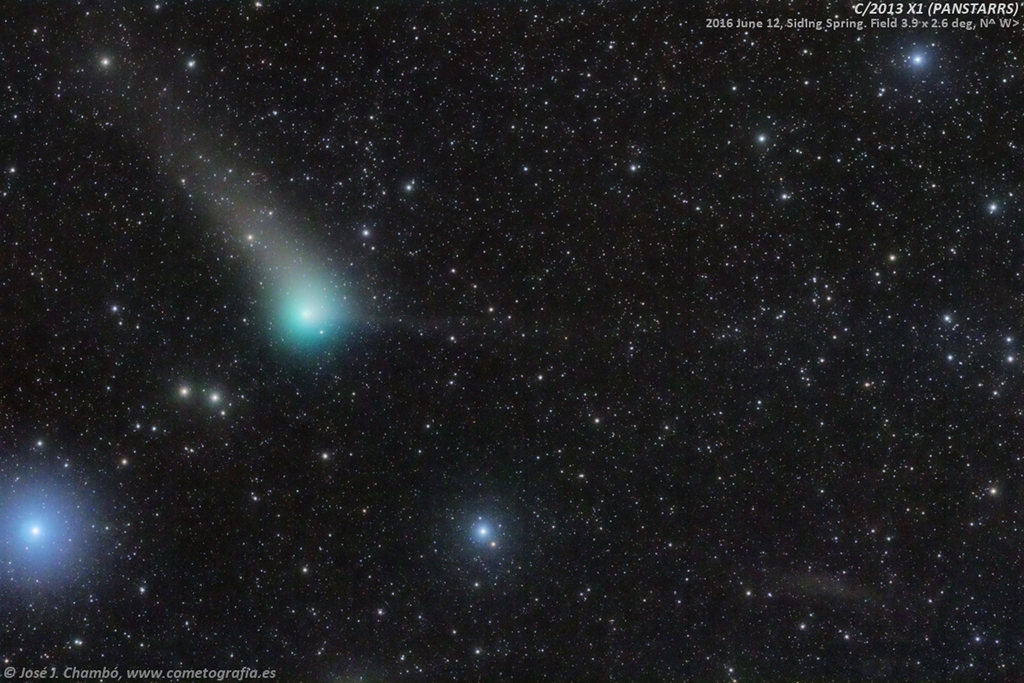
Now approaching our fair planet this Comet PanSTARRS (C/2013 X1) will come closest on June 21-22, a mere 5.3 light-minutes away. By then its appearance low in northern hemisphere predawn skies (high in the south), will be affected by the light of a nearly Full Moon, though. Still the comet's pretty green coma is about the apparent size of the Full Moon in this telescopic portrait, captured on June 12 from the southern hemisphere's Siding Spring Observatory. The deep image also follows a broad, whitish dust tail up and toward the left in the frame, sweeping away from the Sun and trailing behind the comet's orbit. Buffeted by the solar wind, a fainter, narrow ion tail extends horizontally toward the right. On the left edge, the brightest star is bluish Iota Piscis Austrini. Shining at about fourth magnitude, that star is visible to the unaided eye in the constellation of the Southern Fish.