The Sun
The Sun is a yellow dwarf star (G2V), about 4.6 billion years old, and the dominant gravitational force in the Solar System. It has a diameter of roughly 1.4 million kilometers and contains around 99.8% of the Solar System’s mass. Nuclear fusion in its core converts hydrogen into helium, producing energy that warms the planets. Above the core lie the radiative and convective zones, followed by the visible photosphere (~5,500 °C), the chromosphere, and the much hotter corona (~2 million °C).
Source: science.nasa.gov
APODs including "The Sun"
Noctilucent Clouds Tour France
09/07/2016
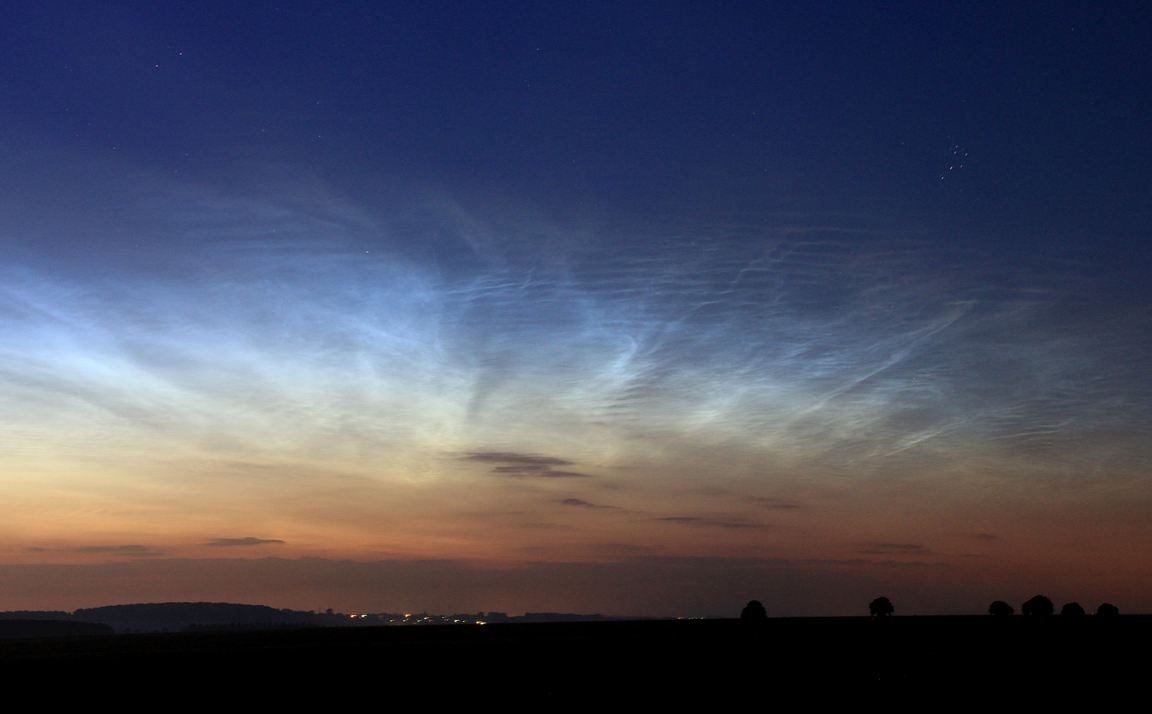
Bright noctilucent or night shining clouds are not familiar sights from northern France. But these electric-blue waves coursed through skies over the small town of Wancourt in Pas-de-Calais on July 6, just before the dawn. From the edge of space, about 80 kilometers above Earth's surface, the icy clouds still reflect sunlight even though the Sun itself is below the horizon as seen from the ground. Usually spotted at high latitudes in summer months the diaphanous apparitions are also known as polar mesospheric clouds. The seasonal clouds are understood to form as water vapor driven into the cold upper atmosphere condenses on the fine dust particles supplied by disintegrating meteors or volcanic ash. NASA's AIM mission provides projections of the noctilucent clouds as seen from space.