The Sun
The Sun is a yellow dwarf star (G2V), about 4.6 billion years old, and the dominant gravitational force in the Solar System. It has a diameter of roughly 1.4 million kilometers and contains around 99.8% of the Solar System’s mass. Nuclear fusion in its core converts hydrogen into helium, producing energy that warms the planets. Above the core lie the radiative and convective zones, followed by the visible photosphere (~5,500 °C), the chromosphere, and the much hotter corona (~2 million °C).
Source: science.nasa.gov
APODs including "The Sun"
Map of Total Solar Eclipse Path in 2017 August
21/08/2016
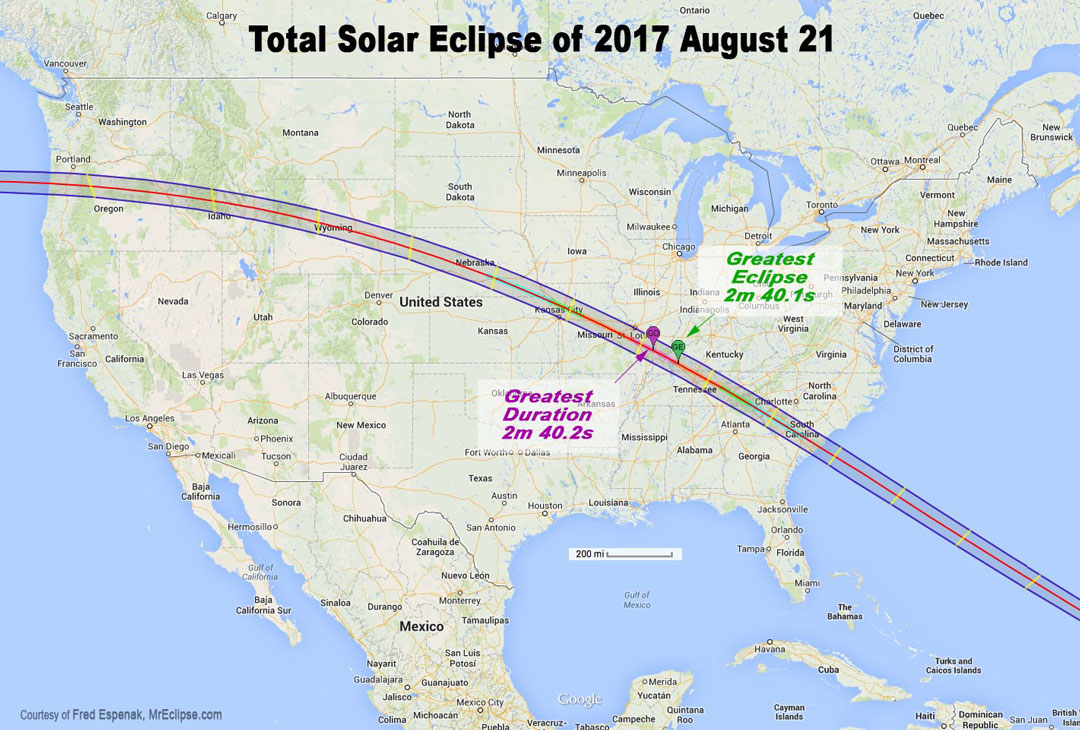
Would you like to see a total eclipse of the Sun? If so, do any friends or relatives live near the path of next summer's eclipse? If yes again, then you might want to arrange a visit for one year from today. Next year on this exact date, the path of a total solar eclipse will cut right across the center of the contiguous USA. All of North America and part of South America will experience, at the least, a partial solar eclipse. Featured here is a map of the path of totality, computed by eclipse expert Fred Espenak of NASA's GSFC. Many people who have seen a total solar eclipse tell stories about it for the rest of their lives. The last path of solar totality that included any part of the contiguous USA was in 1979, and the next two will be in 2024 and 2044. Zoom in: An interactive map of the eclipse path.