The Sun
The Sun is a yellow dwarf star (G2V), about 4.6 billion years old, and the dominant gravitational force in the Solar System. It has a diameter of roughly 1.4 million kilometers and contains around 99.8% of the Solar System’s mass. Nuclear fusion in its core converts hydrogen into helium, producing energy that warms the planets. Above the core lie the radiative and convective zones, followed by the visible photosphere (~5,500 °C), the chromosphere, and the much hotter corona (~2 million °C).
Source: science.nasa.gov
APODs including "The Sun"
Sunset at Edmontonhenge
22/09/2016
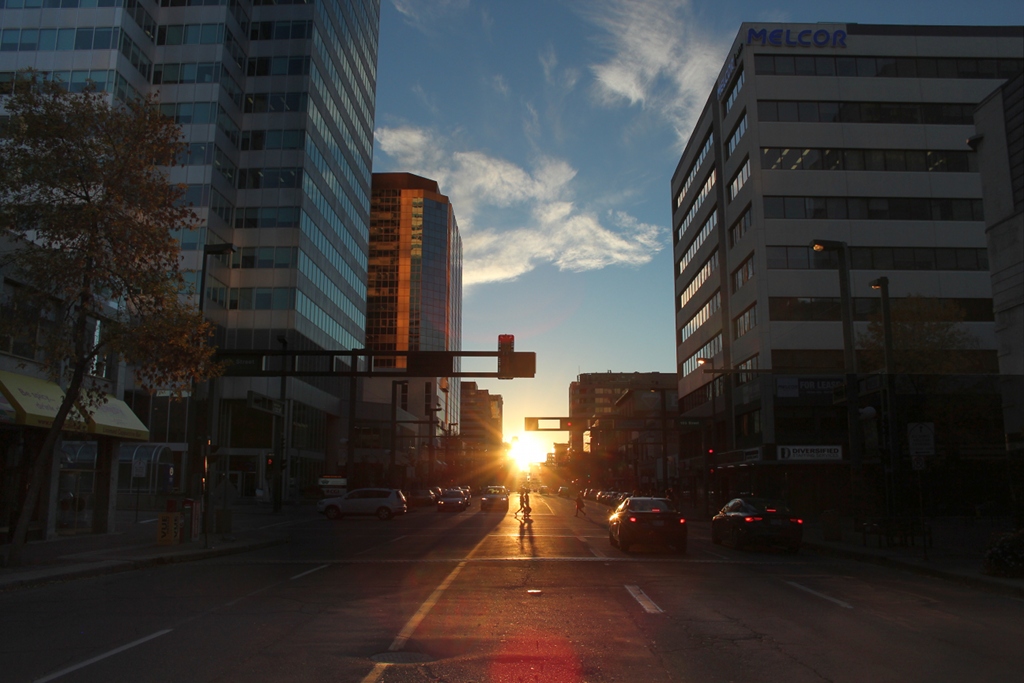
On September 18, the setting Sun illuminated both sides of the steep brick and steel canyon otherwise known as Jasper Avenue in downtown Edmonton, Alberta, Canada, planet Earth. The Stonehenge-like alignment is captured from the middle of the road in this daring snapshot. In Edmonton streets are laid out on a grid almost oriented along the cardinal directions, so aligned Edmonton sunsets (and sunrises) occur along the nearly east-west streets twice a year, close to the Equinox. In fact, at today's Equinox, the Sun crosses the celestial equator at 1421 UT and on this day the Sun will rise due east and set due west, bringing approximately equal hours of day and night to denizens of planet Earth. The September Equinox marks the astronomical beginning of Fall in the north and Spring in the southern hemisphere.