The Sun
The Sun is a yellow dwarf star (G2V), about 4.6 billion years old, and the dominant gravitational force in the Solar System. It has a diameter of roughly 1.4 million kilometers and contains around 99.8% of the Solar System’s mass. Nuclear fusion in its core converts hydrogen into helium, producing energy that warms the planets. Above the core lie the radiative and convective zones, followed by the visible photosphere (~5,500 °C), the chromosphere, and the much hotter corona (~2 million °C).
Source: science.nasa.gov
APODs including "The Sun"
East to West, Light and Shadow
26/11/2016
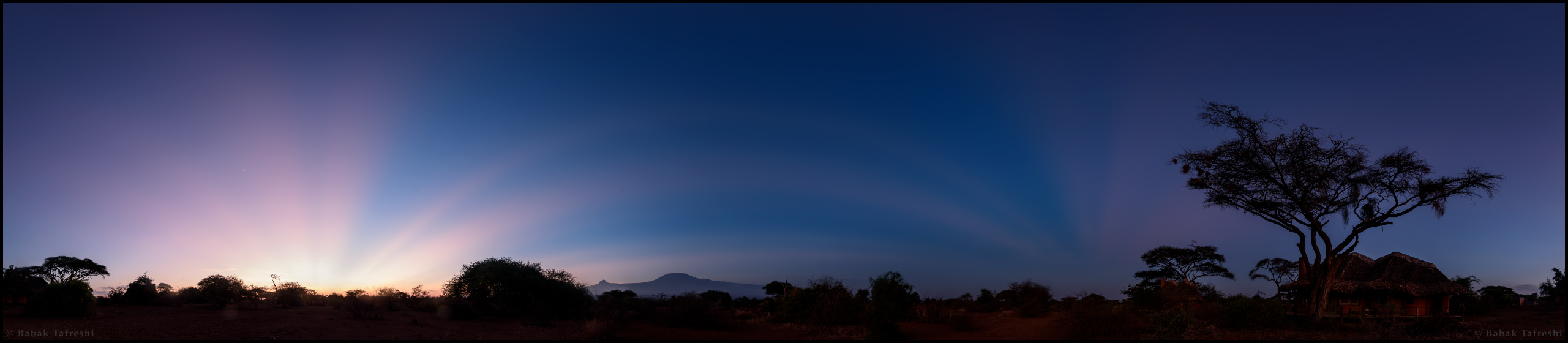
On this November morning an old crescent Moon and morning star rise just before the Sun in a wide panoramic skyscape from Kenya's Amboseli National Park. Still below the limbs of an acacia tree and the eastern horizon, the Sun's position is easy to find though. It's marked at the left by the subtle convergence of light and shadow in the dawn sky. Known as crepuscular rays, the warm-colored rays of sunlight are outlined by shadows cast by unseen clouds near the horizon. Arcing above the profile of Mount Kilimanjaro, toward the right the rays of light and shadow converge at the western horizon. There known as anti-crepuscular rays, they indicate the point opposite the rising sun. The cloud shadows are very nearly parallel, but converge toward the distant horizons because of perspective.