The Sun
The Sun is a yellow dwarf star (G2V), about 4.6 billion years old, and the dominant gravitational force in the Solar System. It has a diameter of roughly 1.4 million kilometers and contains around 99.8% of the Solar System’s mass. Nuclear fusion in its core converts hydrogen into helium, producing energy that warms the planets. Above the core lie the radiative and convective zones, followed by the visible photosphere (~5,500 °C), the chromosphere, and the much hotter corona (~2 million °C).
Source: science.nasa.gov
APODs including "The Sun"
Aurora over Jupiter's South Pole from Juno
06/12/2016
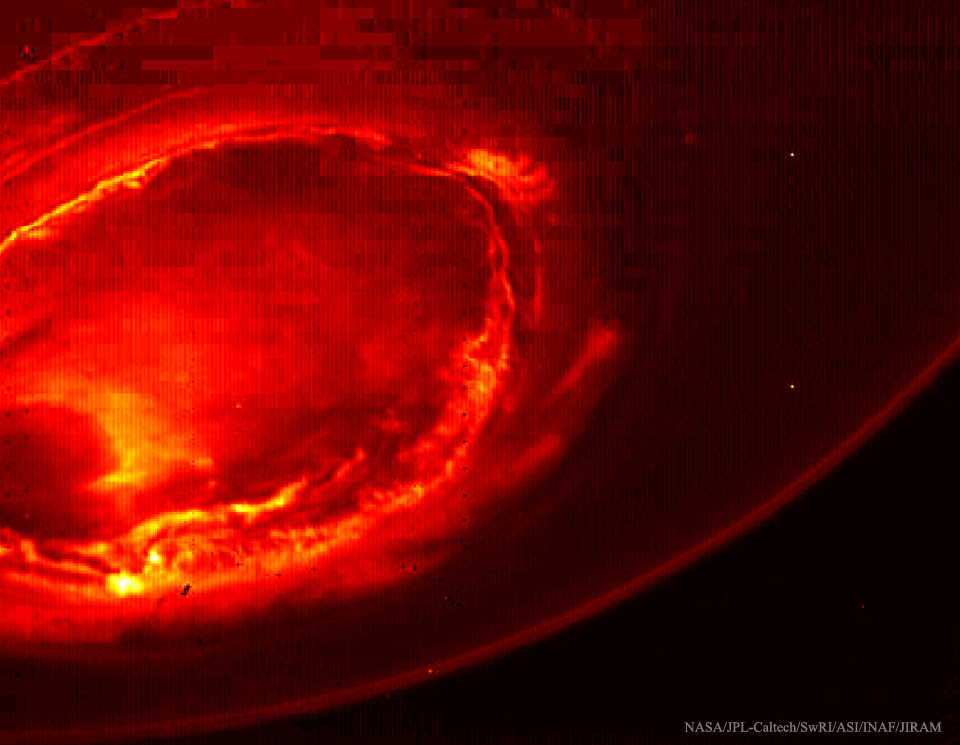
Why is there a glowing oval over Jupiter's South Pole? Aurora. Near the closest part of its first pass near Jupiter in August, NASA's robotic spacecraft Juno captured this dramatic infrared image of a bright auroral ring. Auroras are caused by high energy particles from the Sun interacting with a planet's magnetic field, and ovals around magnetic poles are common. Data from Juno are giving preliminary indications that Jupiter's magnetic field and aurorae are unexpectedly powerful and complex. Unfortunately, a computer glitch caused Juno to go into safe mode during its October pass near the Jovian giant in October. That glitch has now been resolved, making Juno ready for its next pass over Jupiter's cloud tops this coming Sunday.