The Sun
The Sun is a yellow dwarf star (G2V), about 4.6 billion years old, and the dominant gravitational force in the Solar System. It has a diameter of roughly 1.4 million kilometers and contains around 99.8% of the Solar System’s mass. Nuclear fusion in its core converts hydrogen into helium, producing energy that warms the planets. Above the core lie the radiative and convective zones, followed by the visible photosphere (~5,500 °C), the chromosphere, and the much hotter corona (~2 million °C).
Source: science.nasa.gov
APODs including "The Sun"
Layer Cake Sunset
20/01/2017
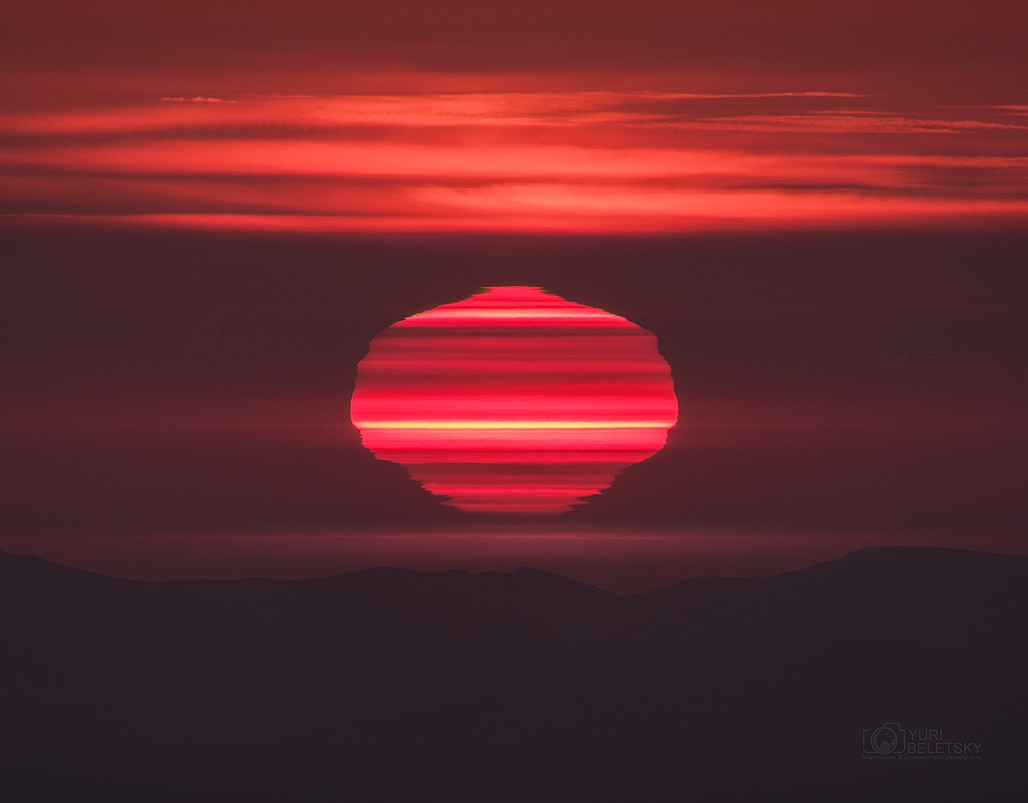
On January 18 a tantalizing sunset was captured in this snapshot. Seemingly sliced into many horizontal layers the Sun shimmered moments before it touched the horizon, setting over the Pacific Ocean as seen from the mountaintop Las Campanas Observatory in Chile. Pink hues of filtered sunlight were created by the long sight-line through the hazy atmosphere. But the remarkable layers correspond to low atmospheric layers of sharply different temperature and density also along the line of sight. Over a long path through each layer the rays of sunlight are refracted strongly and create different images or mirages of sections of the setting Sun. Participate: Take an Aesthetics & Astronomy Survey