The Sun
The Sun is a yellow dwarf star (G2V), about 4.6 billion years old, and the dominant gravitational force in the Solar System. It has a diameter of roughly 1.4 million kilometers and contains around 99.8% of the Solar System’s mass. Nuclear fusion in its core converts hydrogen into helium, producing energy that warms the planets. Above the core lie the radiative and convective zones, followed by the visible photosphere (~5,500 °C), the chromosphere, and the much hotter corona (~2 million °C).
Source: science.nasa.gov
APODs including "The Sun"
Where to See the American Eclipse
31/01/2017
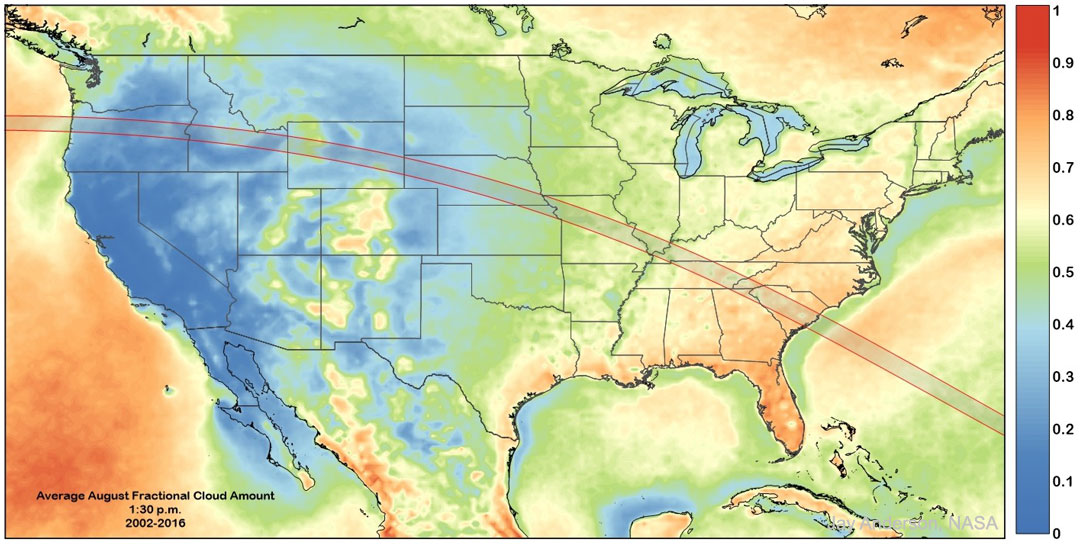
Are you planning to see the American Eclipse on August 21? A few hours after sunrise, a rare total eclipse of the Sun will be visible along a narrow path across the USA. Those only near the path will see a partial eclipse. Although some Americans live right in path of totality, surely many more will be able to get there after a well-planned drive. One problem with eclipses, though, is that clouds sometimes get in the way. To increase your clear-viewing odds, you might consult the featured map and find a convenient destination with a historically low chance (more blue) of thick clouds overhead during totality. Given the large fraction of Americans carrying camera-equipped smartphones, this American Eclipse may turn out to be the most photographed event in the history of the world. Socialize: Plan an eclipse party!