The Sun
The Sun is a yellow dwarf star (G2V), about 4.6 billion years old, and the dominant gravitational force in the Solar System. It has a diameter of roughly 1.4 million kilometers and contains around 99.8% of the Solar System’s mass. Nuclear fusion in its core converts hydrogen into helium, producing energy that warms the planets. Above the core lie the radiative and convective zones, followed by the visible photosphere (~5,500 °C), the chromosphere, and the much hotter corona (~2 million °C).
Source: science.nasa.gov
APODs including "The Sun"
Cloud Swirls around Southern Jupiter from Juno
13/02/2017
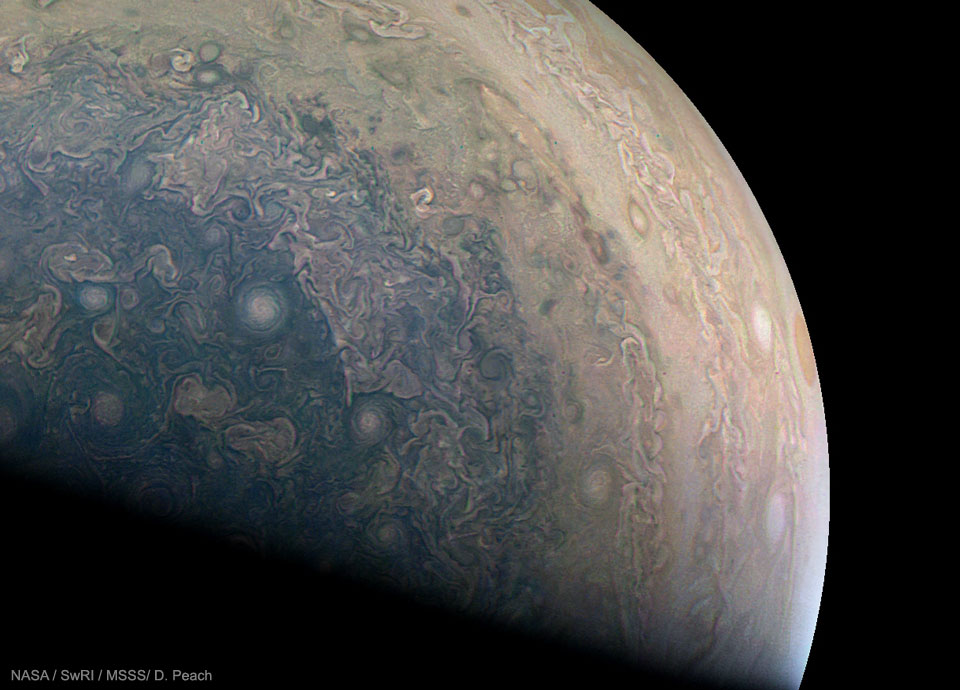
Juno just completed its fourth pass near Jupiter. Launched from Earth in 2011 and arriving at Jupiter just last July, robotic Juno concluded its latest elliptical orbit around our Solar System's largest planet 11 days ago. Pictured here from that pass is a new high-resolution image of the southern hemisphere of Jupiter featuring a mesmerizing tapestry of swirling cloud systems. The terminator between day and night cuts diagonally across the bottom, meaning that the Sun is positioned off the top right. Large Oval BA is visible in orange on the far right. Reasons for the details and colors of Jupiter's cloud swirls are currently unknown. Juno's planned six year mission will study Jovian giant in new ways, including trying to determine if beneath its thick clouds, Jupiter has a solid core.