The Sun
The Sun is a yellow dwarf star (G2V), about 4.6 billion years old, and the dominant gravitational force in the Solar System. It has a diameter of roughly 1.4 million kilometers and contains around 99.8% of the Solar System’s mass. Nuclear fusion in its core converts hydrogen into helium, producing energy that warms the planets. Above the core lie the radiative and convective zones, followed by the visible photosphere (~5,500 °C), the chromosphere, and the much hotter corona (~2 million °C).
Source: science.nasa.gov
APODs including "The Sun"
The Comet, the Owl, and the Galaxy
24/03/2017
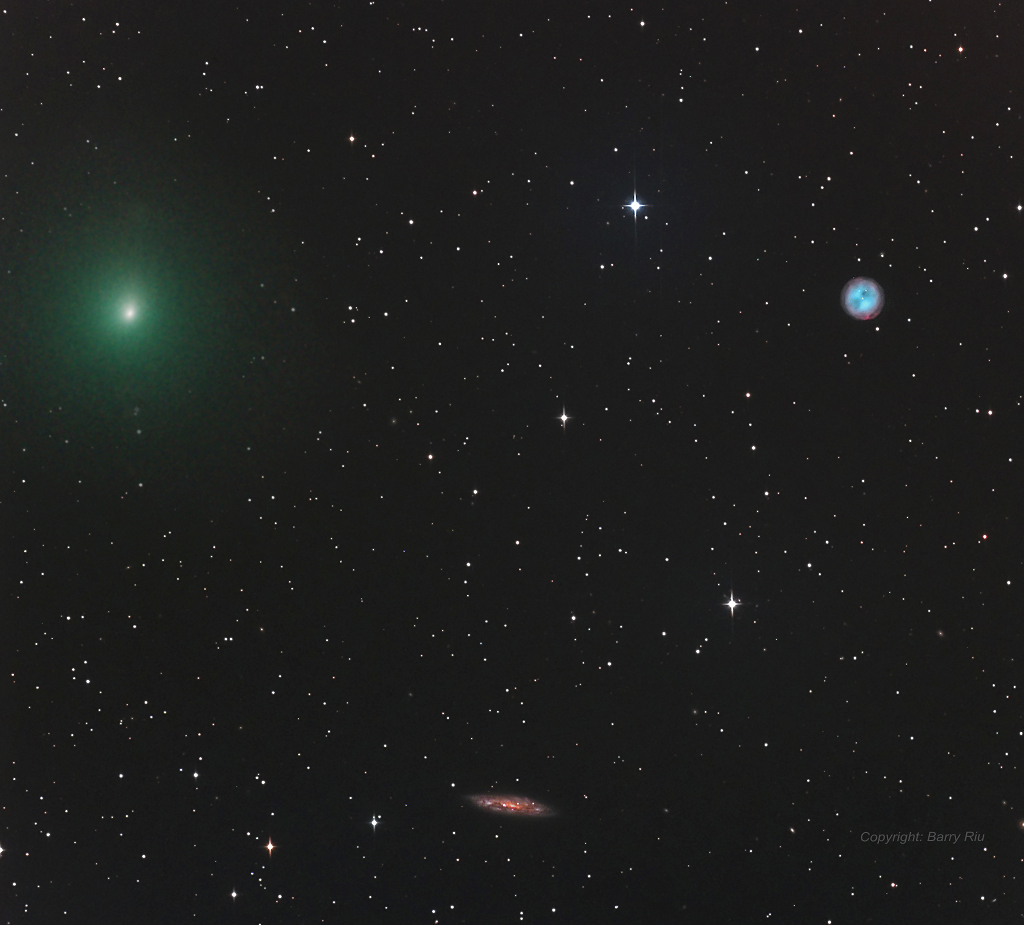
Comet 41P/Tuttle-Giacobini-Kresak poses for a Messier moment in this telescopic snapshot from March 21. In fact it shares the 1 degree wide field-of-view with two well-known entries in the 18th century comet-hunting astronomer's famous catalog. Sweeping through northern springtime skies just below the Big Dipper, the faint greenish comet was about 75 light-seconds from our fair planet. Dusty, edge-on spiral galaxy Messier 108 (bottom center) is more like 45 million light-years away. At upper right, the planetary nebula with an aging but intensely hot central star, the owlish Messier 97 is only about 12 thousand light-years distant though, still well within our own Milky Way galaxy. Named for its discoverer and re-discoverers, this faint periodic comet was first sighted in 1858 and not again until 1907 and 1951. Matching orbit calculations indicated that the same comet had been observed at widely separated times. Nearing its best apparition and closest approach to Earth in over 100 years on April 1, comet 41P orbits the Sun with a period of about 5.4 years.