The Sun
The Sun is a yellow dwarf star (G2V), about 4.6 billion years old, and the dominant gravitational force in the Solar System. It has a diameter of roughly 1.4 million kilometers and contains around 99.8% of the Solar System’s mass. Nuclear fusion in its core converts hydrogen into helium, producing energy that warms the planets. Above the core lie the radiative and convective zones, followed by the visible photosphere (~5,500 °C), the chromosphere, and the much hotter corona (~2 million °C).
Source: science.nasa.gov
APODs including "The Sun"
Plane Contrail and Sun Halo
04/04/2017
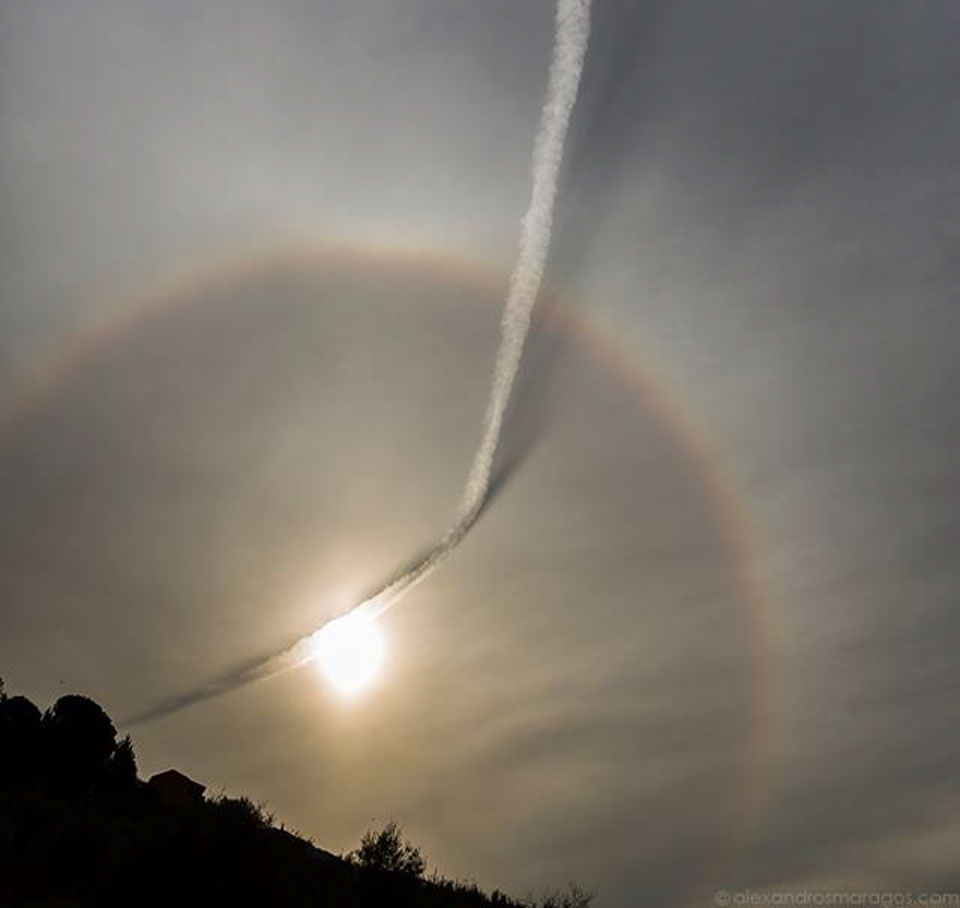
What's happened to the sky? Several common features of the daytime sky are interacting in uncommon ways. First, well behind the silhouetted hills, is the typically bright Sun. In front of the Sun are thin clouds, possibly the home to a layer of hexagonal ice crystals that together are creating the 22 degree halo of light surrounding the Sun. The unusual bent line that crosses the image is a contrail -- a type of cloud created by a passing airplane. Much of the contrail must actually be further away than the thin cloud because it casts a shadow onto the cloud, giving an unusual three-dimensional quality to the featured image. The featured image was taken in late January in the city of Patras in West Greece.