The Sun
The Sun is a yellow dwarf star (G2V), about 4.6 billion years old, and the dominant gravitational force in the Solar System. It has a diameter of roughly 1.4 million kilometers and contains around 99.8% of the Solar System’s mass. Nuclear fusion in its core converts hydrogen into helium, producing energy that warms the planets. Above the core lie the radiative and convective zones, followed by the visible photosphere (~5,500 °C), the chromosphere, and the much hotter corona (~2 million °C).
Source: science.nasa.gov
APODs including "The Sun"
Life-Enabling Plumes above Enceladus
16/04/2017
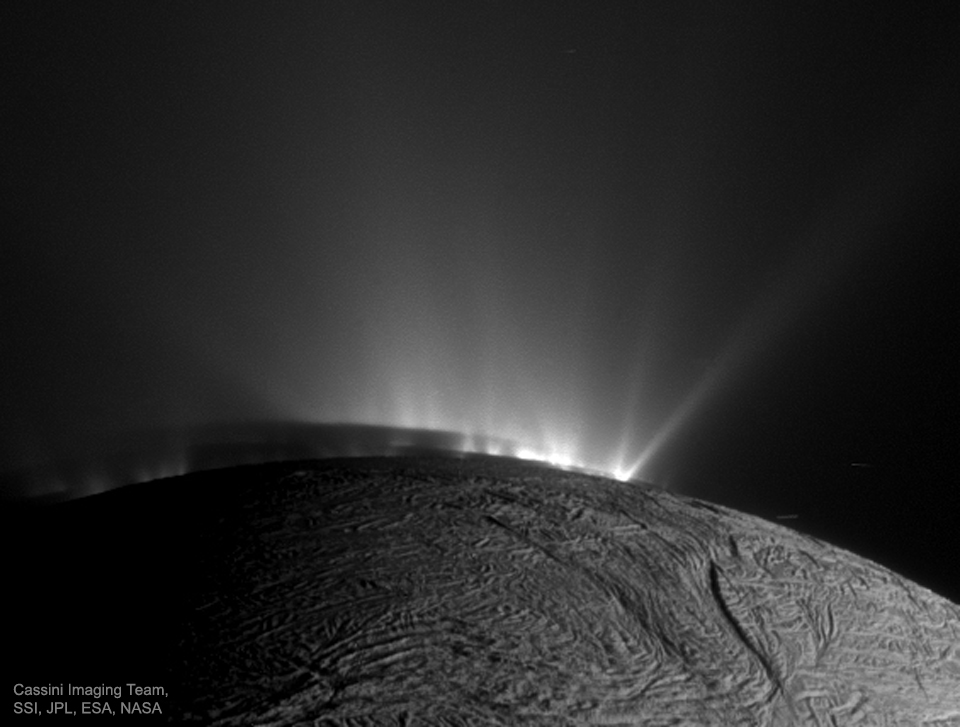
Does Enceladus have underground oceans that could support life? The discovery of jets spewing water vapor and ice was detected by the Saturn-orbiting Cassini spacecraft in 2005. The origin of the water feeding the jets, however, was originally unknown. Since discovery, evidence has been accumulating that Enceladus has a deep underground sea, warmed by tidal flexing. Pictured here, the textured surface of Enceladus is visible in the foreground, while rows of plumes rise from ice fractures in the distance. These jets are made more visible by the Sun angle and the encroaching shadow of night. A recent fly-through has found evidence that a plume -- and so surely the underlying sea -- is rich in molecular hydrogen, a viable food source for microbes that could potentially be living there.