The Sun
The Sun is a yellow dwarf star (G2V), about 4.6 billion years old, and the dominant gravitational force in the Solar System. It has a diameter of roughly 1.4 million kilometers and contains around 99.8% of the Solar System’s mass. Nuclear fusion in its core converts hydrogen into helium, producing energy that warms the planets. Above the core lie the radiative and convective zones, followed by the visible photosphere (~5,500 °C), the chromosphere, and the much hotter corona (~2 million °C).
Source: science.nasa.gov
APODs including "The Sun"
A Split Ion Tail for Comet Lovejoy E4
25/04/2017
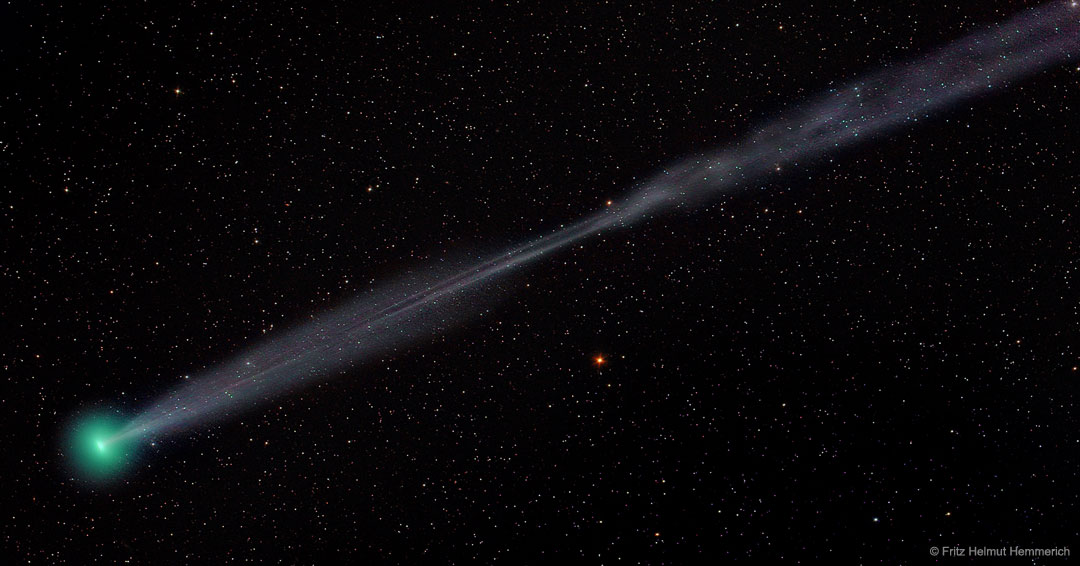
What's happened to Comet Lovejoy? In the pictured image, a processed composite, the comet was captured early this month after brightening unexpectedly and sporting a long and intricate ion tail. Remarkably, the typically complex effect of the Sun's wind and magnetic field here caused the middle of Comet Lovejoy's ion tail to resemble the head of a needle. Comet C/2017 E4 (Lovejoy) was discovered only last month by noted comet discoverer Terry Lovejoy. The comet reached visual magnitude 7 earlier this month, making it a good target for binoculars and long duration exposure cameras. What's happened to Comet Lovejoy (E4) since this image was taken might be considered even more remarkable -- the comet's nucleus appeared to be disintegrating and fading as it neared its closest approach to the Sun two days ago.