The Sun
The Sun is a yellow dwarf star (G2V), about 4.6 billion years old, and the dominant gravitational force in the Solar System. It has a diameter of roughly 1.4 million kilometers and contains around 99.8% of the Solar System’s mass. Nuclear fusion in its core converts hydrogen into helium, producing energy that warms the planets. Above the core lie the radiative and convective zones, followed by the visible photosphere (~5,500 °C), the chromosphere, and the much hotter corona (~2 million °C).
Source: science.nasa.gov
APODs including "The Sun"
The Bull's Eye and the Young Moon
05/05/2017
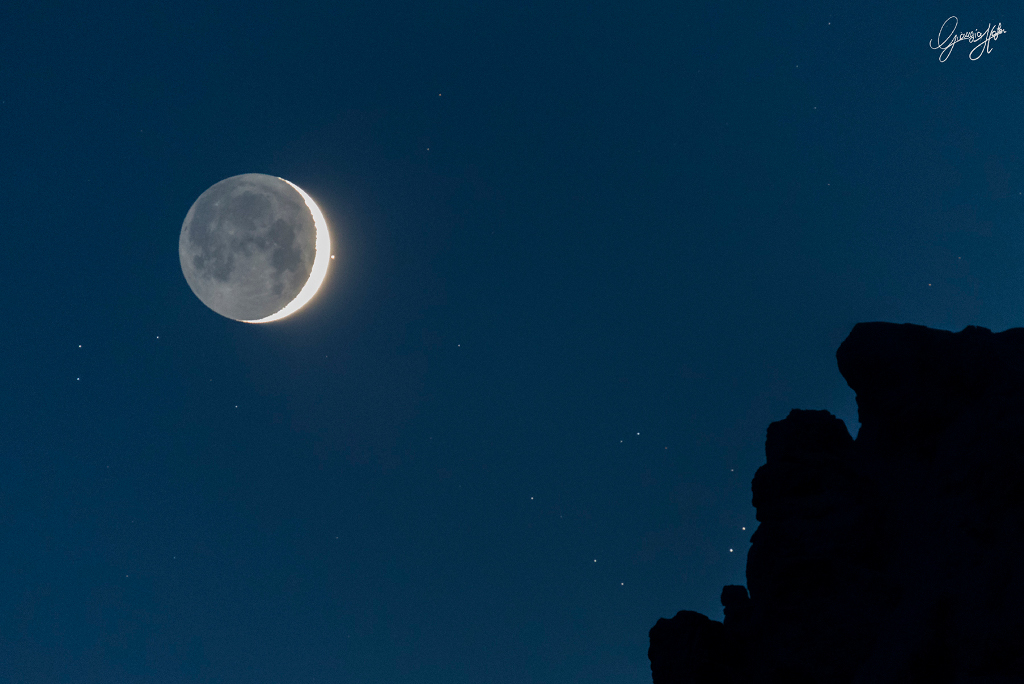
Aldebaran, eye of Taurus the Bull, and a young crescent Moon shared an early evening sky last Friday. The lovely celestial pairing could be enjoyed around planet Earth, but from some locations the Moon was even seen to pass in front of Aldebaran, a dramatic lunar occultation of the familiar bright star. Taken at nightfall on April 28, this skyscape captures Aldebaran shortly after it emerged from behind the bright lunar limb. In the foreground are craggy peaks of the Dolomite mountains near Laggio di Cadore, Italy. Before reappearing beyond the sunlit crescent, Aldebaran first winked out behind the Moon's ashen glow, the lunar nightside faintly illuminated by earthshine.