The Sun
The Sun is a yellow dwarf star (G2V), about 4.6 billion years old, and the dominant gravitational force in the Solar System. It has a diameter of roughly 1.4 million kilometers and contains around 99.8% of the Solar System’s mass. Nuclear fusion in its core converts hydrogen into helium, producing energy that warms the planets. Above the core lie the radiative and convective zones, followed by the visible photosphere (~5,500 °C), the chromosphere, and the much hotter corona (~2 million °C).
Source: science.nasa.gov
APODs including "The Sun"
A Kalahari Sky
30/05/2017
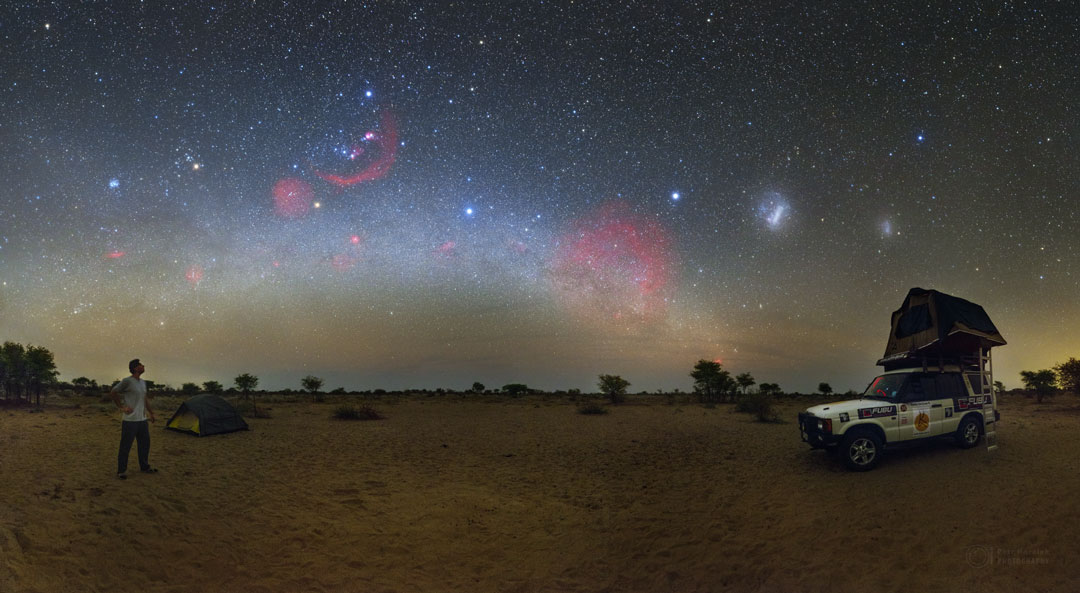
You wake up in the Kalahari Desert in Botswana, Africa. You go outside your tent, set up your camera, and take long exposures of the land and sky. What might you see? Besides a lot of blowing dust and the occasional acacia tree, you might catch many sky wonders. Pictured in 2015 September, sky highlights include the central band of our Milky Way Galaxy, the Pleiades Star Cluster, Barnard's Loop, and both the Large and Small Magellanic Clouds, to name just a few. Although most of these faded in the morning light, they were quickly replaced by a partial eclipse of the Sun. Free Presentation: APOD Editor to speak in Prague on June 30