The Sun
The Sun is a yellow dwarf star (G2V), about 4.6 billion years old, and the dominant gravitational force in the Solar System. It has a diameter of roughly 1.4 million kilometers and contains around 99.8% of the Solar System’s mass. Nuclear fusion in its core converts hydrogen into helium, producing energy that warms the planets. Above the core lie the radiative and convective zones, followed by the visible photosphere (~5,500 °C), the chromosphere, and the much hotter corona (~2 million °C).
Source: science.nasa.gov
APODs including "The Sun"
Shadowrise and Sunset
01/06/2017
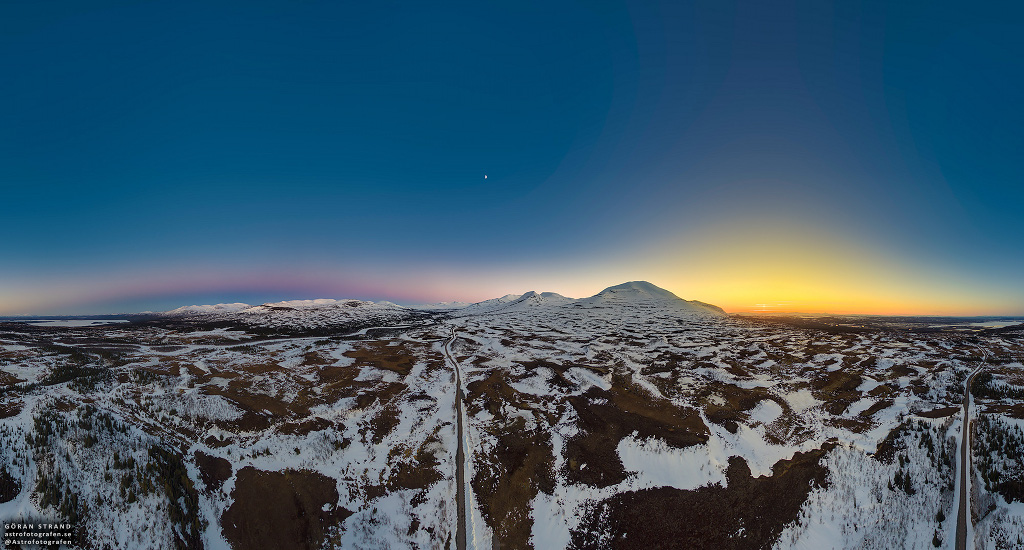
The road tracking through this stunning 360 degree view crosses a remote mountain area of Jämtland, Sweden, planet Earth. A 3x8 mosaic of still images, the panorama was taken on May 3rd from a small drone 200 meters above the ground. The scene records the warm light of the Sun setting in the northwest and the planet's dark shadow rising in the southeast. A small sun pillar gives away the Sun's position just below the horizon while the pinkish anti-twilight arch or belt of Venus outlines Earth's shadow. In the middle of the remarkably clear sky, the First Quarter Moon is visible above the mountains, its half illuminated disk separating shadowrise and sunset. A range of exposures was used to cover the large difference in sky brightness. The tallest peak left of the sunset is Storsnasen, some 1400 meters above sea level.