The Sun
The Sun is a yellow dwarf star (G2V), about 4.6 billion years old, and the dominant gravitational force in the Solar System. It has a diameter of roughly 1.4 million kilometers and contains around 99.8% of the Solar System’s mass. Nuclear fusion in its core converts hydrogen into helium, producing energy that warms the planets. Above the core lie the radiative and convective zones, followed by the visible photosphere (~5,500 °C), the chromosphere, and the much hotter corona (~2 million °C).
Source: science.nasa.gov
APODs including "The Sun"
Aphelion Sunrise
05/07/2017
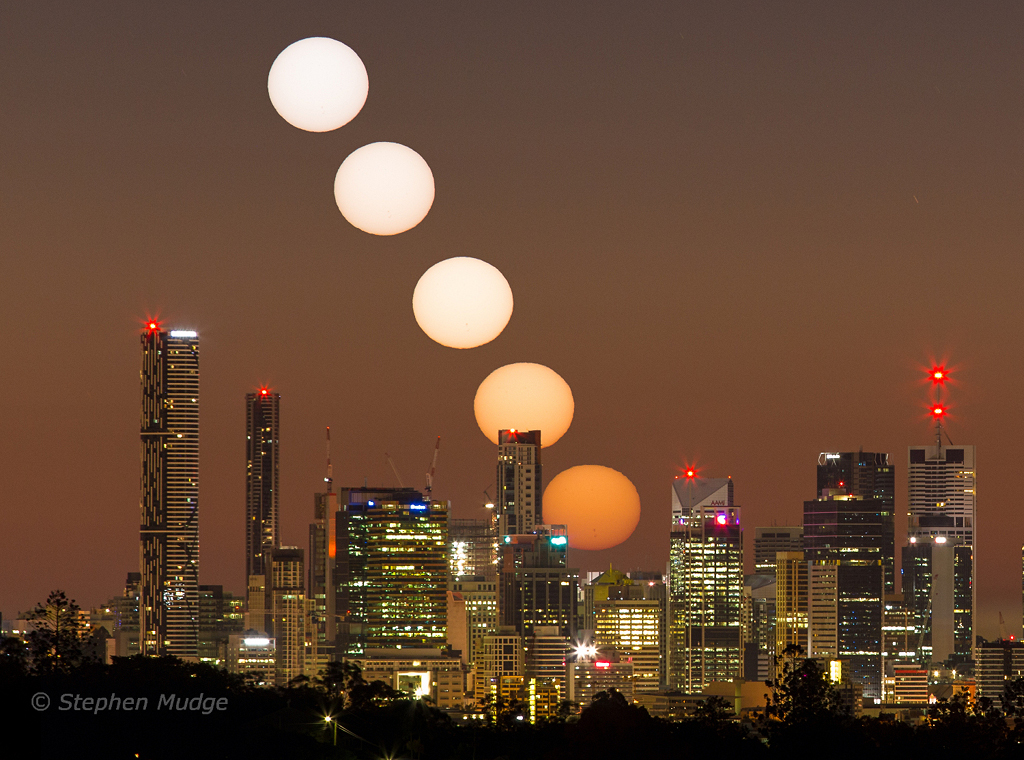
On July 3rd, planet Earth reached aphelion, the farthest point in its elliptical orbit around the Sun. Each year, this day of the most distant Sun happens to occur during winter in the southern hemisphere. That's where this aphelion sunrise from 2015 was captured in a time series composite against the skyline of Brisbane, Australia. Of course, seasons for our fair planet are not determined by distance to the Sun, but by the tilt of Earth's rotational axis with respect to the ecliptic, the plane of its orbit. Fondly known as the obliquity of the ecliptic, the angle of the tilt is about 23.4 degrees from perpendicular to the orbital plane. So the most distant sunrise occurs during northern summer, when the planet's north pole is tilted toward the Sun and the north enjoys longer, warmer days.