The Sun
The Sun is a yellow dwarf star (G2V), about 4.6 billion years old, and the dominant gravitational force in the Solar System. It has a diameter of roughly 1.4 million kilometers and contains around 99.8% of the Solar System’s mass. Nuclear fusion in its core converts hydrogen into helium, producing energy that warms the planets. Above the core lie the radiative and convective zones, followed by the visible photosphere (~5,500 °C), the chromosphere, and the much hotter corona (~2 million °C).
Source: science.nasa.gov
APODs including "The Sun"
Ireson Hill on Mars
19/07/2017
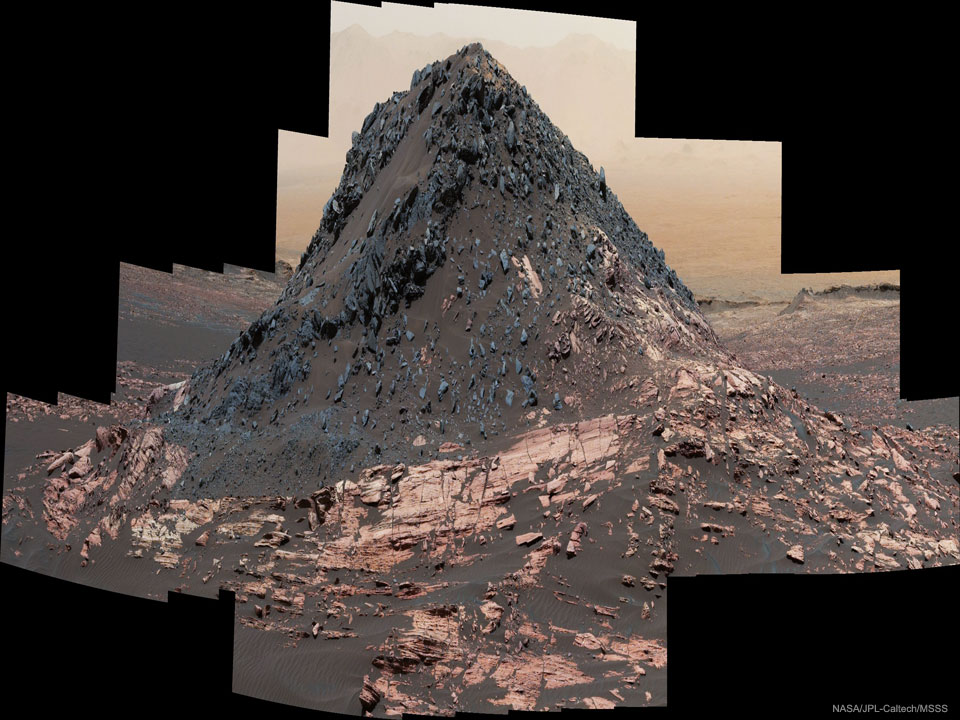
What created this unusual hill on Mars? Its history has become a topic of research, but its shape and two-tone structure makes it one of the more unusual hills that the robotic Curiosity rover on Mars has rolled near. Dubbed Ireson Hill, the mound rises about 5 meters high and spans about 15 meters across. Ireson Hill is located on the Bagnold Dune field on the slope of Mount Sharp in Gale Crater on Mars. The featured 41-image panorama has been horizontally compressed to include the entire hill. The image was taken on February 2 and released last week. Because Mars is moving behind the Sun as seen from the Earth, NASA will soon stop sending commands to its Martian orbiters and rovers until about August 1. Explore the Universe: Random APOD Generator