The Sun
The Sun is a yellow dwarf star (G2V), about 4.6 billion years old, and the dominant gravitational force in the Solar System. It has a diameter of roughly 1.4 million kilometers and contains around 99.8% of the Solar System’s mass. Nuclear fusion in its core converts hydrogen into helium, producing energy that warms the planets. Above the core lie the radiative and convective zones, followed by the visible photosphere (~5,500 °C), the chromosphere, and the much hotter corona (~2 million °C).
Source: science.nasa.gov
APODs including "The Sun"
Apollo 11: Catching Some Sun
22/07/2017
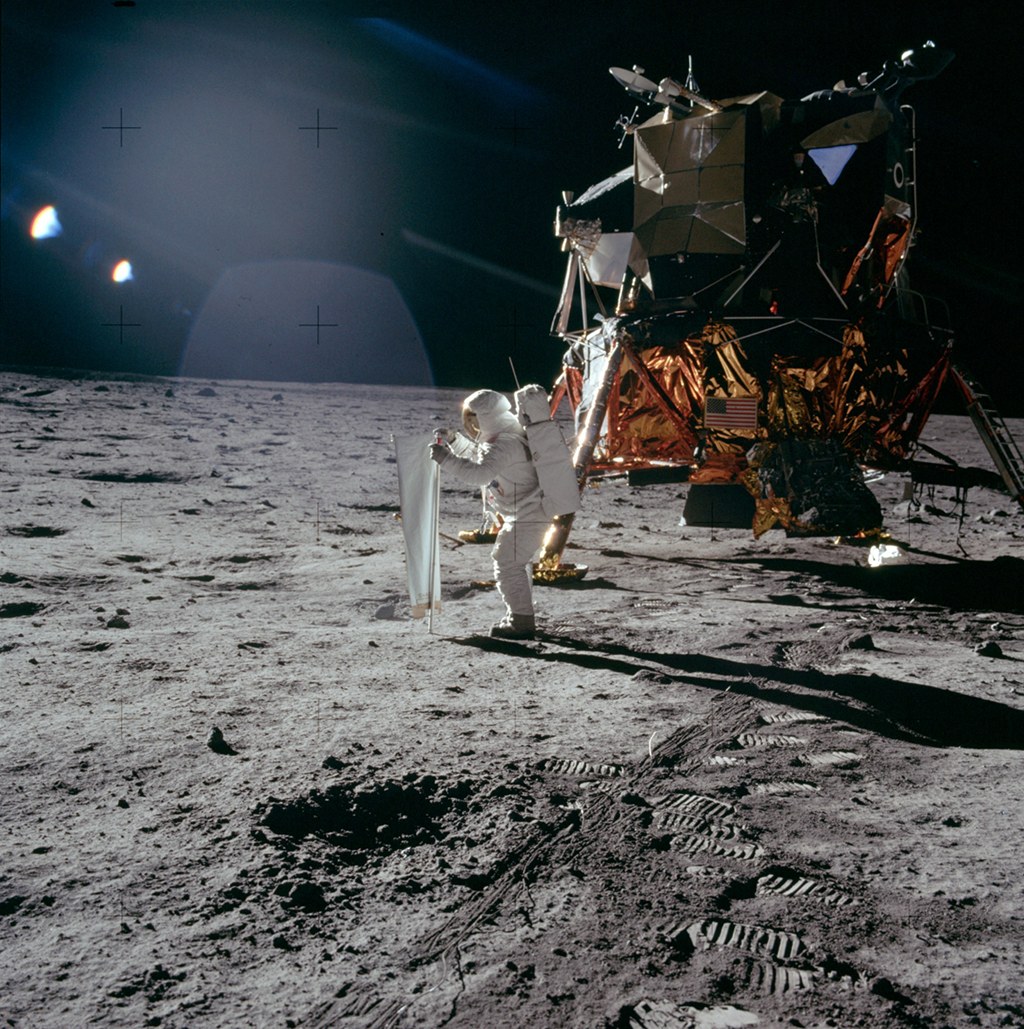
Bright sunlight glints and long dark shadows mark this image of the lunar surface. It was taken July 20, 1969 by Apollo 11 astronaut Neil Armstrong, the first to walk on the Moon. Pictured is the mission's lunar module, the Eagle, and spacesuited lunar module pilot Buzz Aldrin unfurling a long sheet of foil also known as the Solar Wind Composition Experiment. Exposed facing the Sun, the foil trapped particles streaming outward in the solar wind, catching a sample of material from the Sun itself. Along with moon rocks and lunar soil samples, the solar wind collector was returned for analysis in earthbound laboratories.