The Sun
The Sun is a yellow dwarf star (G2V), about 4.6 billion years old, and the dominant gravitational force in the Solar System. It has a diameter of roughly 1.4 million kilometers and contains around 99.8% of the Solar System’s mass. Nuclear fusion in its core converts hydrogen into helium, producing energy that warms the planets. Above the core lie the radiative and convective zones, followed by the visible photosphere (~5,500 °C), the chromosphere, and the much hotter corona (~2 million °C).
Source: science.nasa.gov
APODs including "The Sun"
Milky Way Voyager
02/09/2017
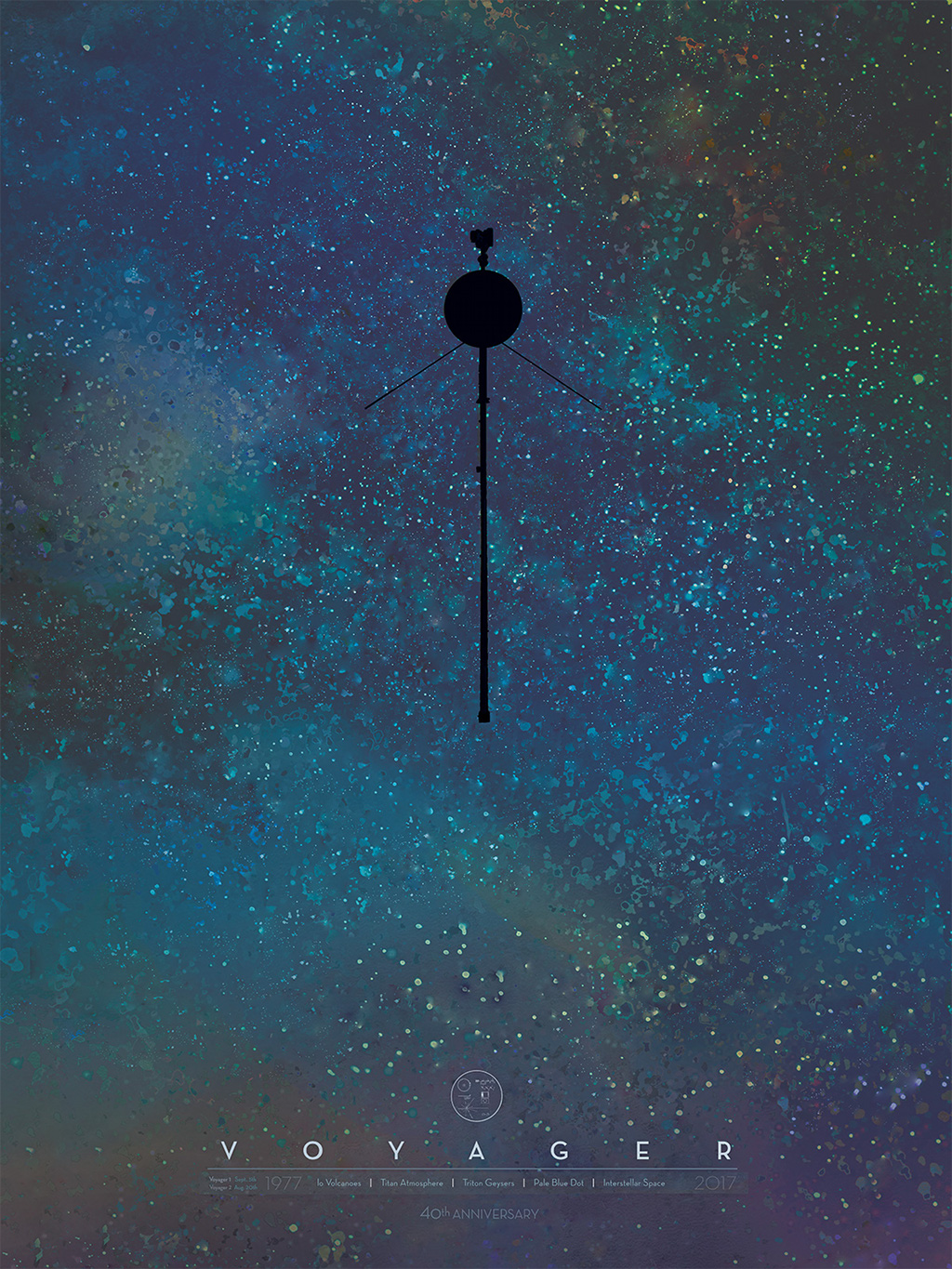
Launched in 1977 on a tour of the outer planets of the Solar System, Voyager 1 and 2 have become the longest operating and most distant spacecraft from Earth. Nearly 16 light-hours from the Sun, Voyager 2 has reached the edge of the heliosphere, the realm defined by the influence of the solar wind and the Sun's magnetic field. Now humanity's first ambassador to the Milky Way, Voyager 1 is over 19 light-hours away, beyond the heliosphere in interstellar space. Celebrate the Voyagers' 40 year journey toward the stars with NASA on September 5. Poster: Downloads