The Sun
The Sun is a yellow dwarf star (G2V), about 4.6 billion years old, and the dominant gravitational force in the Solar System. It has a diameter of roughly 1.4 million kilometers and contains around 99.8% of the Solar System’s mass. Nuclear fusion in its core converts hydrogen into helium, producing energy that warms the planets. Above the core lie the radiative and convective zones, followed by the visible photosphere (~5,500 °C), the chromosphere, and the much hotter corona (~2 million °C).
Source: science.nasa.gov
APODs including "The Sun"
The Climber and the Eclipse
06/09/2017
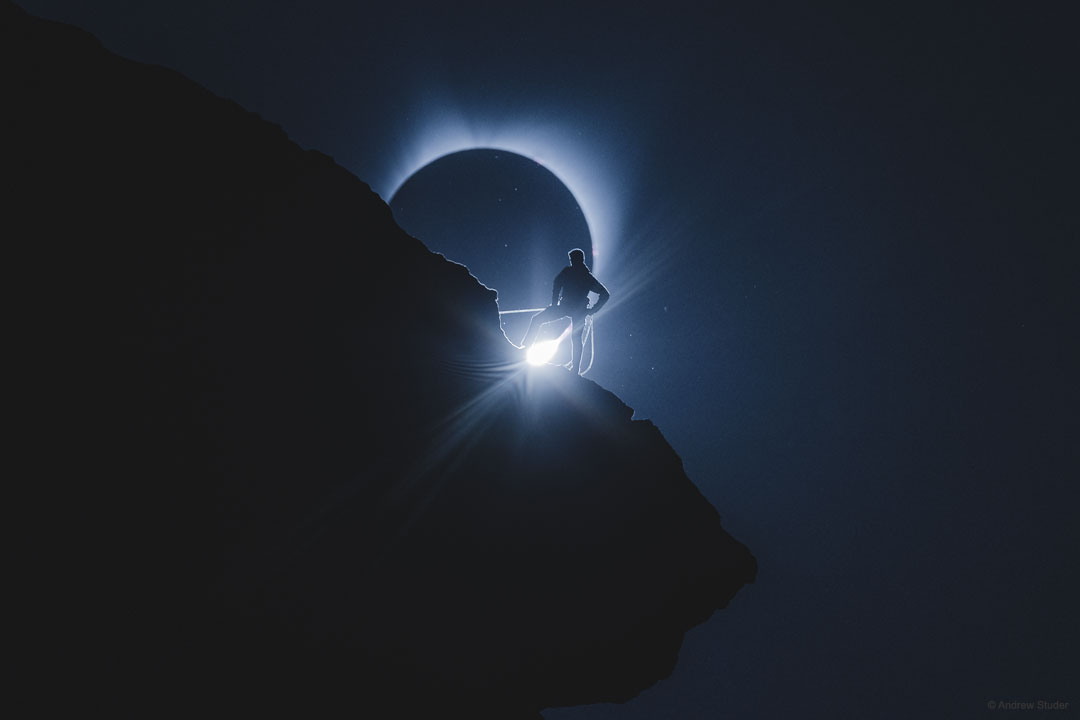
What should you do if your rock climbing picture is photobombed by a total eclipse of the Sun? Rejoice -- because your planning paid off. After months of considering different venues, and a week of scouting different locations in Oregon's Smith Rock State Park, a group of photographers and rock climbers led by Andrew Struder, Ted Hesser, Martina Tibell, and Michael Shainblum settled on picturesque 100-meter tall Monkey Face tower as the dramatic foreground for their images of the pending total solar eclipse. Tension mounted as the eclipse time approached, planned juxtapositions were scrutinized, and the placement of rock climber Tommy Smith was adjusted. Right on schedule, though, the Moon moved in front of the Sun, and Smith moved in front of the Moon, just as planned. The solar eclipse image displayed here actually shows a diamond ring, an eclipse phase when a bit of the distant Sun is still visible beyond the Moon's surface. Open Science: Browse 1,500+ codes in the Astrophysics Source Code Library