The Sun
The Sun is a yellow dwarf star (G2V), about 4.6 billion years old, and the dominant gravitational force in the Solar System. It has a diameter of roughly 1.4 million kilometers and contains around 99.8% of the Solar System’s mass. Nuclear fusion in its core converts hydrogen into helium, producing energy that warms the planets. Above the core lie the radiative and convective zones, followed by the visible photosphere (~5,500 °C), the chromosphere, and the much hotter corona (~2 million °C).
Source: science.nasa.gov
APODs including "The Sun"
The Great Gig in the Sky
08/09/2017
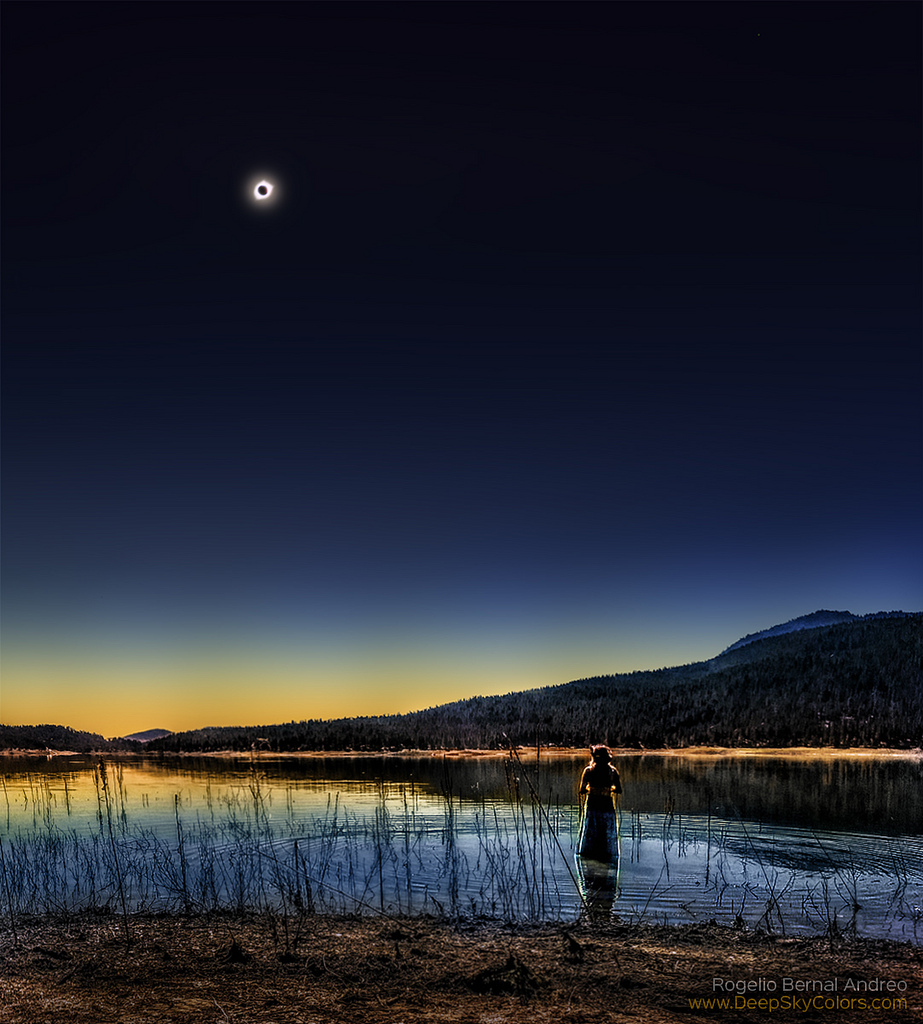
There were no crowds on the beach at Phillips Lake, Oregon on August 21. But a few had come there to stand, for a moment, in the dark shadow of the Moon. From the beach, this unscripted mosaic photo records their much anticipated solar eclipse. In two vertical panels it catches the last few seconds of totality and the first instant of 3rd contact, just as the eclipse ends and sunlight faintly returns. Across the US those gathered along the path of totality also took pictures and shared their moment. And like those at Phillips Lake they may treasure the experience more than any planned or unplanned photograph of the total eclipse of the Sun.