The Sun
The Sun is a yellow dwarf star (G2V), about 4.6 billion years old, and the dominant gravitational force in the Solar System. It has a diameter of roughly 1.4 million kilometers and contains around 99.8% of the Solar System’s mass. Nuclear fusion in its core converts hydrogen into helium, producing energy that warms the planets. Above the core lie the radiative and convective zones, followed by the visible photosphere (~5,500 °C), the chromosphere, and the much hotter corona (~2 million °C).
Source: science.nasa.gov
APODs including "The Sun"
Flare Well AR2673
14/09/2017
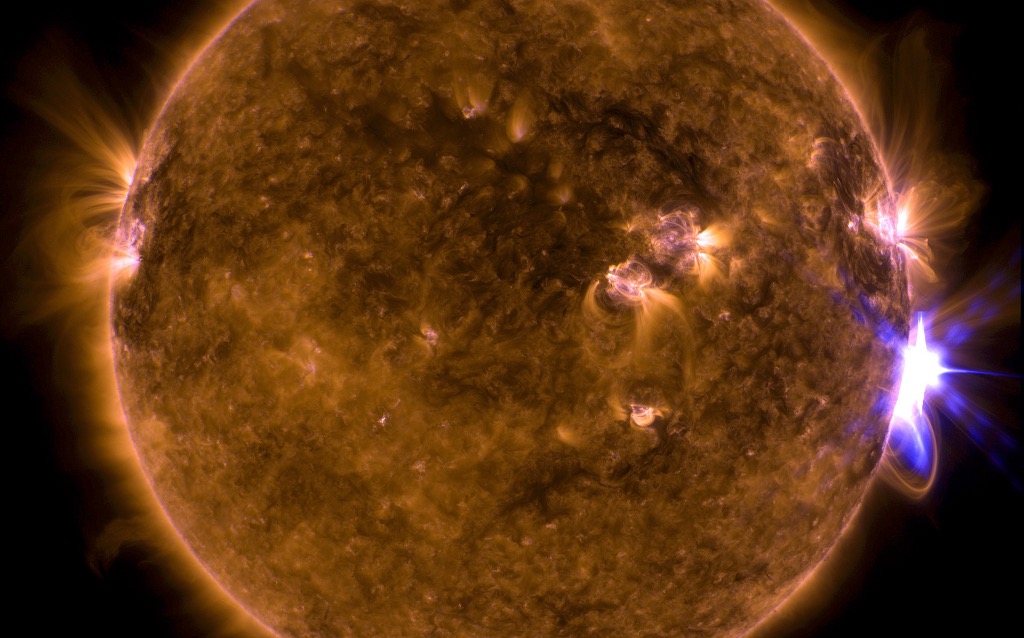
Almost out of view from our fair planet, rotating around the Sun's western edge giant active region AR2673 lashed out with another intense solar flare followed by a large coronal mass ejection on September 10. The flare itself is seen here at the right in an extreme ultraviolet image from the sun-staring Solar Dynamics Observatory. This intense flare was the fourth X-class flare from AR2673 this month. The active region's most recent associated coronal mass ejection collided with Earth's magnetosphere 2 days later. Say farewell to the mighty AR2673, for now. For the next two weeks, the powerful sunspot group will be on the Sun's far side. Mission: Farewell Cassini