The Sun
The Sun is a yellow dwarf star (G2V), about 4.6 billion years old, and the dominant gravitational force in the Solar System. It has a diameter of roughly 1.4 million kilometers and contains around 99.8% of the Solar System’s mass. Nuclear fusion in its core converts hydrogen into helium, producing energy that warms the planets. Above the core lie the radiative and convective zones, followed by the visible photosphere (~5,500 °C), the chromosphere, and the much hotter corona (~2 million °C).
Source: science.nasa.gov
APODs including "The Sun"
Solar Eclipse Solargraph
22/09/2017
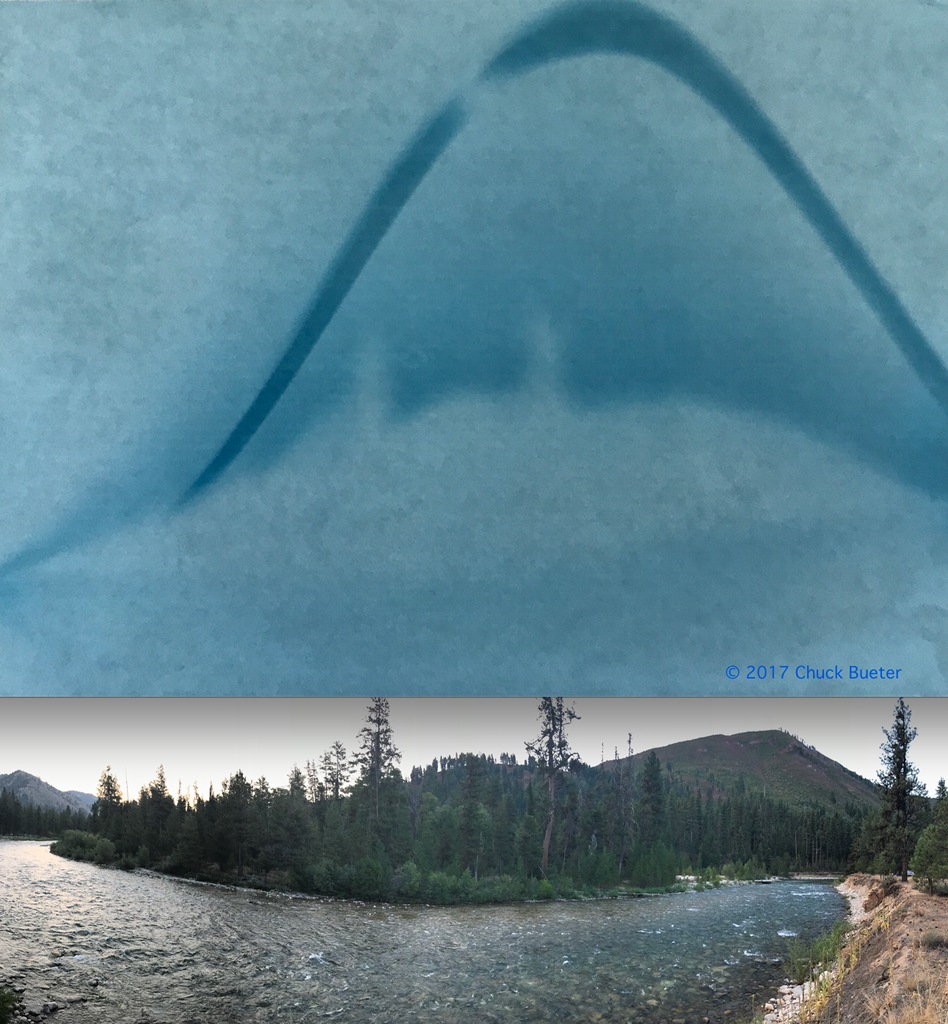
Today is the September equinox. Heading south, the Sun's path through the sky will cross the celestial equator at 20:02 UT. Of course the equinox date results in (mostly) equal night and day all over planet Earth. But on August 21 the Sun's path through the sky found a little extra-night for some. Made with a drink can pinhole camera and light-sensitive paper, this creative solargraph follows the Sun's path on that date. An all-day exposure, it traces the Sun's arc still rising high in northern skies, aligned with a panoramic snapshot of the local landscape at the bottom. The gap in the arc represents the duration of the partial and total phases of the solar eclipse in clear skies over Lowman, Idaho, USA. There, the extra-night (totality) lasted for about 2 minutes. The broad gap in the Sun's arc also covers the loss of sunlight during the more extended partial eclipse phases.