The Sun
The Sun is a yellow dwarf star (G2V), about 4.6 billion years old, and the dominant gravitational force in the Solar System. It has a diameter of roughly 1.4 million kilometers and contains around 99.8% of the Solar System’s mass. Nuclear fusion in its core converts hydrogen into helium, producing energy that warms the planets. Above the core lie the radiative and convective zones, followed by the visible photosphere (~5,500 °C), the chromosphere, and the much hotter corona (~2 million °C).
Source: science.nasa.gov
APODs including "The Sun"
Cassini's Last Ring Portrait at Saturn
26/09/2017
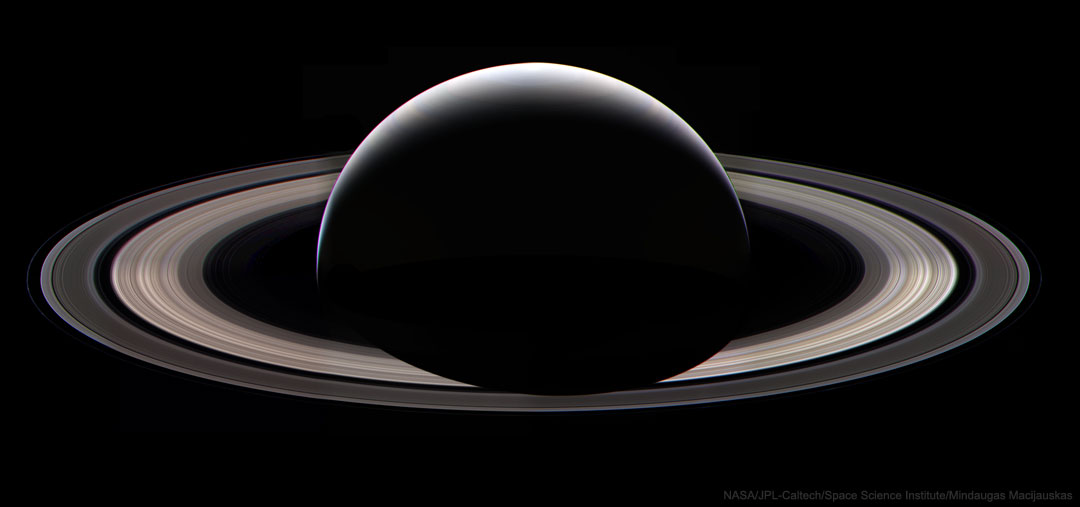
How should Cassini say farewell to Saturn? Three days before plunging into Saturn's sunny side, the robotic Cassini spacecraft swooped far behind Saturn's night side with cameras blazing. Thirty-six of these images have been merged -- by an alert and adept citizen scientist -- into a last full-ring portrait of Cassini's home planet for the past 13 years. The Sun is just above the frame, causing Saturn to cast a dark shadow onto its enormous rings. This shadow position cannot be imaged from Earth and will not be visible again until another Earth-launched spaceship visits the ringed giant. Data and images from Cassini's mission-ending dive into Saturn's atmosphere on September 15 continue to be analyzed. Almost Hyperspace: Random APOD Generator