The Sun
The Sun is a yellow dwarf star (G2V), about 4.6 billion years old, and the dominant gravitational force in the Solar System. It has a diameter of roughly 1.4 million kilometers and contains around 99.8% of the Solar System’s mass. Nuclear fusion in its core converts hydrogen into helium, producing energy that warms the planets. Above the core lie the radiative and convective zones, followed by the visible photosphere (~5,500 °C), the chromosphere, and the much hotter corona (~2 million °C).
Source: science.nasa.gov
APODs including "The Sun"
Haumea of the Outer Solar System
17/10/2017
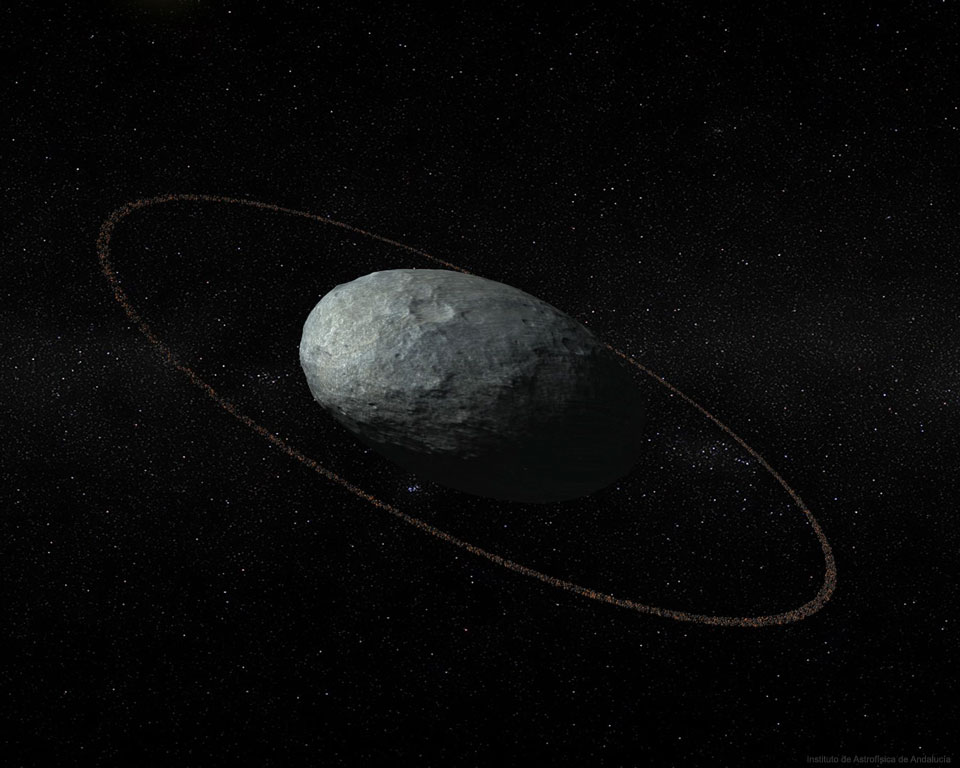
One of the strangest objects in the outer Solar System has recently been found to have a ring. The object, named Haumea, is the fifth designated dwarf planet after Pluto, Ceres, Eris, and Makemake. Haumea's oblong shape makes it quite unusual. Along one direction, Haumea is significantly longer than Pluto, while in another direction Haumea has an extent very similar to Pluto, while in the third direction is much smaller. Haumea's orbit sometimes brings it closer to the Sun than Pluto, but usually Haumea is further away. Illustrated above, an artist visualizes Haumea as a cratered ellipsoid surrounded by a uniform ring. Originally discovered in 2003 and given the temporary designation of 2003 EL61, Haumea was renamed in 2008 by the IAU for a Hawaiian goddess. Besides the ring discovered this year, Haumea has two small moons discovered in 2005, named Hi'iaka and Namaka for daughters of the goddess.