The Sun
The Sun is a yellow dwarf star (G2V), about 4.6 billion years old, and the dominant gravitational force in the Solar System. It has a diameter of roughly 1.4 million kilometers and contains around 99.8% of the Solar System’s mass. Nuclear fusion in its core converts hydrogen into helium, producing energy that warms the planets. Above the core lie the radiative and convective zones, followed by the visible photosphere (~5,500 °C), the chromosphere, and the much hotter corona (~2 million °C).
Source: science.nasa.gov
APODs including "The Sun"
The Kepler-90 Planetary System
18/12/2017
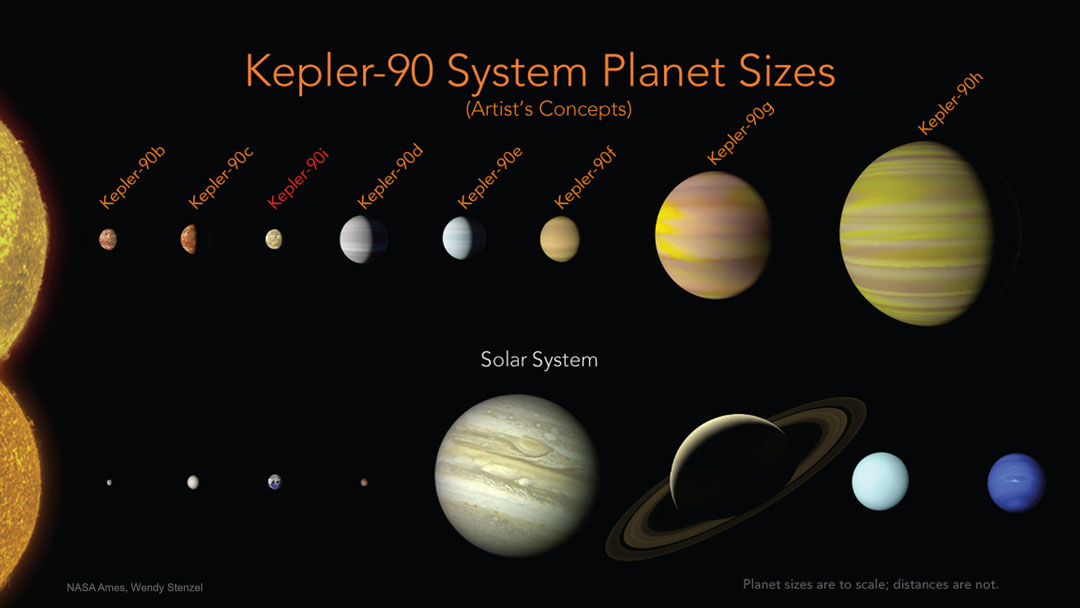
Do other stars have planetary systems like our own? Yes -- one such system is Kepler-90. Cataloged by the orbiting Kepler satellite, an eighth planet has now been discovered giving Kepler-90 the same number of known planets as our Solar System. Similarities between Kepler-90 and our system include a G-type star comparable to our Sun, rocky planets comparable to our Earth, and large planets comparable in size to Jupiter and Saturn. Differences include that all of the known Kepler-90 planets orbit relatively close in -- closer than Earth's orbit around the Sun -- making them possibly too hot to harbor life. However, observations over longer time periods may discover cooler planets further out. Kepler-90 lies about 2,500 light years away, and at magnitude 14 is visible with a medium-sized telescope toward the constellation of the Dragon (Draco). Exoplanet-finding missions planned for launch in the next decade include TESS, JWST, WFIRST, and PLATO.