The Sun
The Sun is a yellow dwarf star (G2V), about 4.6 billion years old, and the dominant gravitational force in the Solar System. It has a diameter of roughly 1.4 million kilometers and contains around 99.8% of the Solar System’s mass. Nuclear fusion in its core converts hydrogen into helium, producing energy that warms the planets. Above the core lie the radiative and convective zones, followed by the visible photosphere (~5,500 °C), the chromosphere, and the much hotter corona (~2 million °C).
Source: science.nasa.gov
APODs including "The Sun"
Blue Comet PanSTARRS
12/01/2018
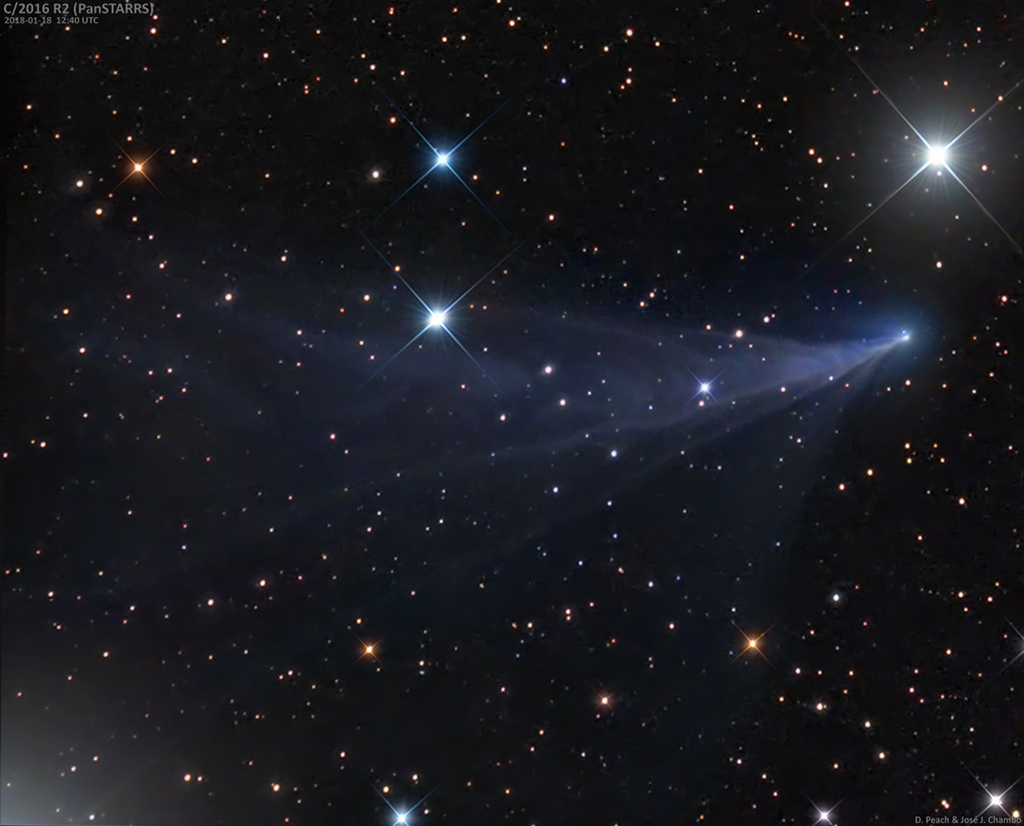
Discovered with the PanSTARRS telescope on September 7, 2016, this Comet PanSTARRS, C/2016 R2, is presently about 24 light minutes (3 AU) from the Sun, sweeping through planet Earth's skies across the background of stars in the constellation Taurus. An inbound visitor from our Solar System's distant Oort Cloud, its beautiful and complex ion tail is a remarkable shade of blue. Still relatively far from the Sun, the comet's already well-developed ion tail is very impressive. Emission from unusually abundant ionized carbon monoxide (CO+) molecules fluorescing in the increasing sunlight is largely responsible for the pretty blue tint. This color image of the blue comet is a combination of data taken from two different telescopes during the night of January 7. Located at the apex of the V-shaped Hyades star cluster in Taurus, bright star Gamma Tauri is responsible for the glow at the bottom left corner of the frame.