The Sun
The Sun is a yellow dwarf star (G2V), about 4.6 billion years old, and the dominant gravitational force in the Solar System. It has a diameter of roughly 1.4 million kilometers and contains around 99.8% of the Solar System’s mass. Nuclear fusion in its core converts hydrogen into helium, producing energy that warms the planets. Above the core lie the radiative and convective zones, followed by the visible photosphere (~5,500 °C), the chromosphere, and the much hotter corona (~2 million °C).
Source: science.nasa.gov
APODs including "The Sun"
Blue Comet Meets Blue Stars
12/02/2018
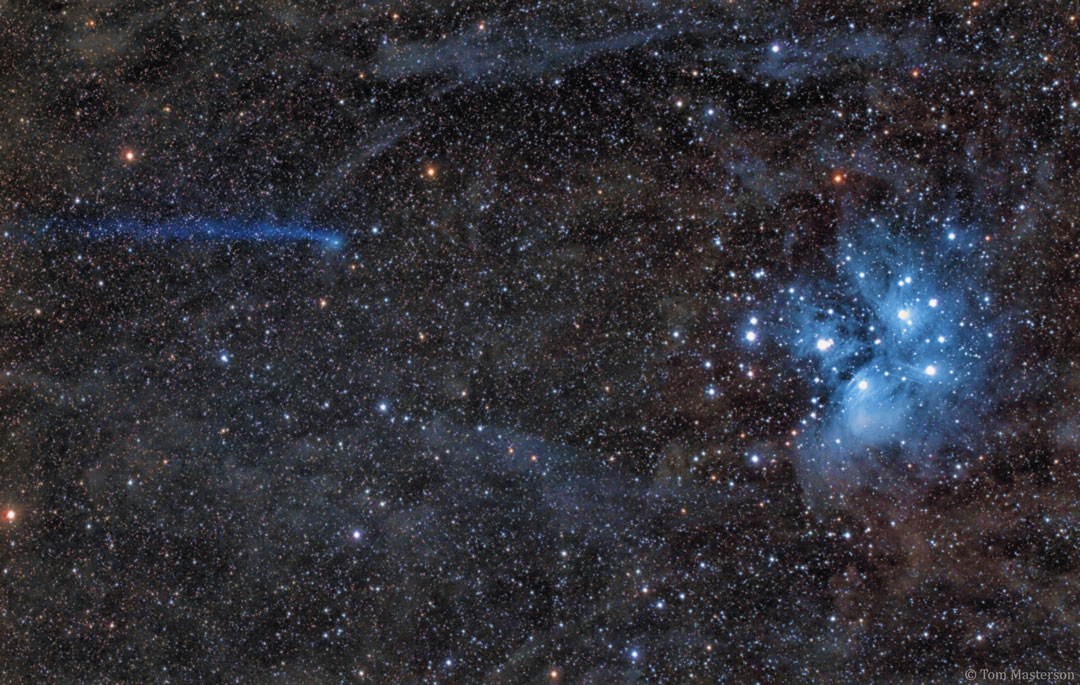
What's that heading for the Pleiades star cluster? It appears to be Comet C/2016 R2 (PanSTARRS), but here, appearances are deceiving. On the right and far in the background, the famous Pleiades star cluster is dominated by blue light from massive young stars. On the left and visiting the inner Solar System is Comet PanSTARRS, a tumbling block of ice from the outer Solar System that currently sports a long ion tail dominated by blue light from an unusually high abundance of ionized carbon monoxide. Comet PanSTARRS is actually moving toward the top of the image, and its ion tail points away from the Sun but is affected by a complex solar wind of particles streaming out from the Sun. Visible through a small telescope, the comet is fading as it recedes from the Earth, even though it reaches its closest point to the Sun in early May.