The Sun
The Sun is a yellow dwarf star (G2V), about 4.6 billion years old, and the dominant gravitational force in the Solar System. It has a diameter of roughly 1.4 million kilometers and contains around 99.8% of the Solar System’s mass. Nuclear fusion in its core converts hydrogen into helium, producing energy that warms the planets. Above the core lie the radiative and convective zones, followed by the visible photosphere (~5,500 °C), the chromosphere, and the much hotter corona (~2 million °C).
Source: science.nasa.gov
APODs including "The Sun"
Enceladus in Silhouette
15/02/2018
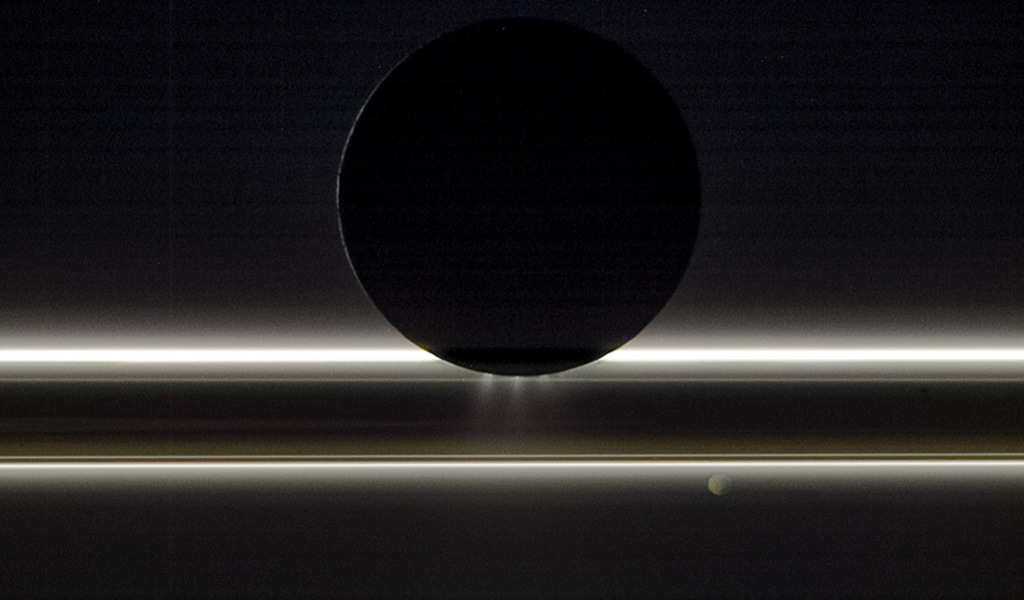
One of our Solar System's most tantalizing worlds, Enceladus is backlit by the Sun in this Cassini spacecraft image from November 1, 2009. The dramatic illumination reveals the plumes that continuously spew into space from the south pole of Saturn's 500 kilometer diameter moon. Discovered by Cassini in 2005, the icy plumes are likely connected to an ocean beneath the ice shell of Enceladus. They supply material directly to Saturn's outer, tenuous E ring and make the surface of Enceladus as reflective as snow. Across the scene, Saturn's icy rings scatter sunlight toward Cassini's cameras. Beyond the rings, the night side of 80 kilometer diameter moon Pandora is faintly lit by Saturnlight.