The Sun
The Sun is a yellow dwarf star (G2V), about 4.6 billion years old, and the dominant gravitational force in the Solar System. It has a diameter of roughly 1.4 million kilometers and contains around 99.8% of the Solar System’s mass. Nuclear fusion in its core converts hydrogen into helium, producing energy that warms the planets. Above the core lie the radiative and convective zones, followed by the visible photosphere (~5,500 °C), the chromosphere, and the much hotter corona (~2 million °C).
Source: science.nasa.gov
APODs including "The Sun"
NGC 1360: The Robin's Egg Nebula
11/05/2018
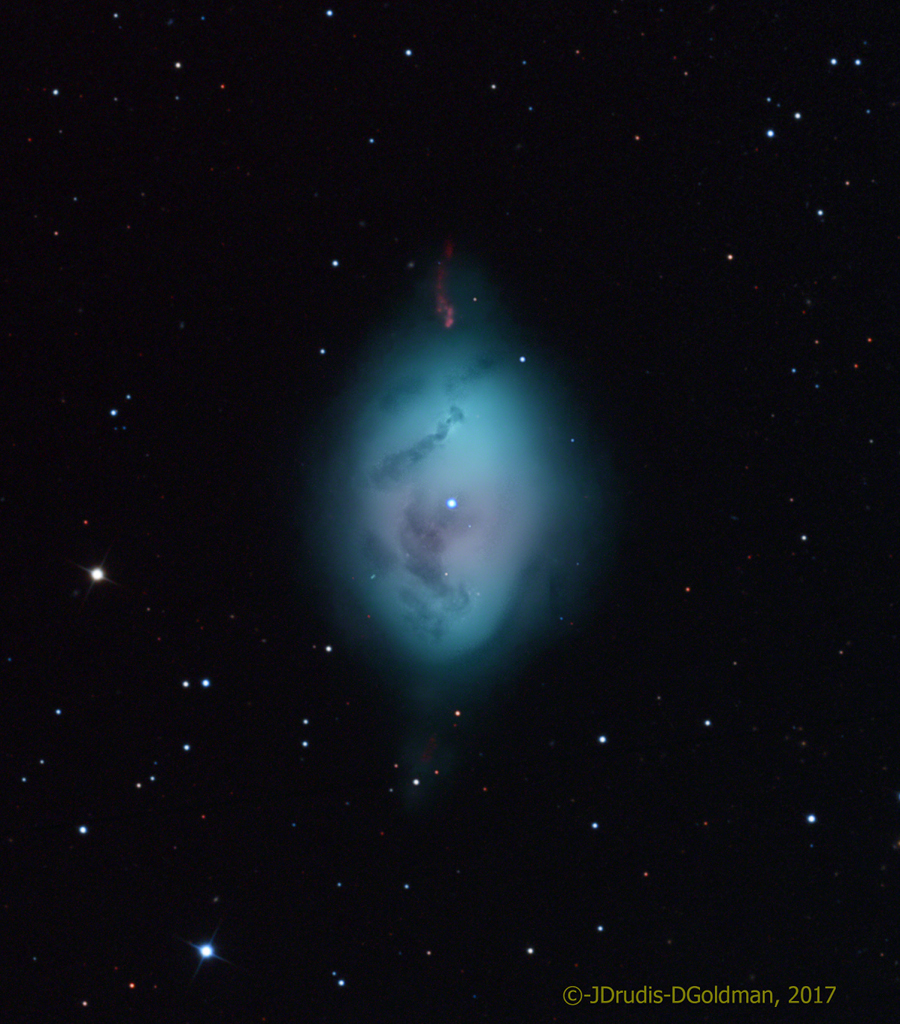
This pretty cosmic cloud lies some 1,500 light-years away, it shape and color reminiscent of a blue robin's egg. It spans about 3 light-years, nested securely within the boundaries of the southern constellation Fornax. Recognized as a planetary nebula, NGC 1360 doesn't represent a beginning though. Instead it corresponds to a brief and final phase in the evolution of an aging star. In fact, visible in the telescopic image the central star of NGC 1360 is known to be a binary star system likely consisting of two evolved white dwarf stars, less massive but much hotter than the Sun. Their intense and otherwise invisible ultraviolet radiation has stripped away electrons from the atoms in the surrounding gaseous shroud. The predominant blue-green hue of NGC 1360 seen here is the strong emission produced as electrons recombine with doubly ionized oxygen atoms.