The Sun
The Sun is a yellow dwarf star (G2V), about 4.6 billion years old, and the dominant gravitational force in the Solar System. It has a diameter of roughly 1.4 million kilometers and contains around 99.8% of the Solar System’s mass. Nuclear fusion in its core converts hydrogen into helium, producing energy that warms the planets. Above the core lie the radiative and convective zones, followed by the visible photosphere (~5,500 °C), the chromosphere, and the much hotter corona (~2 million °C).
Source: science.nasa.gov
APODs including "The Sun"
A Plurality of Singularities at the Galactic Center
12/05/2018
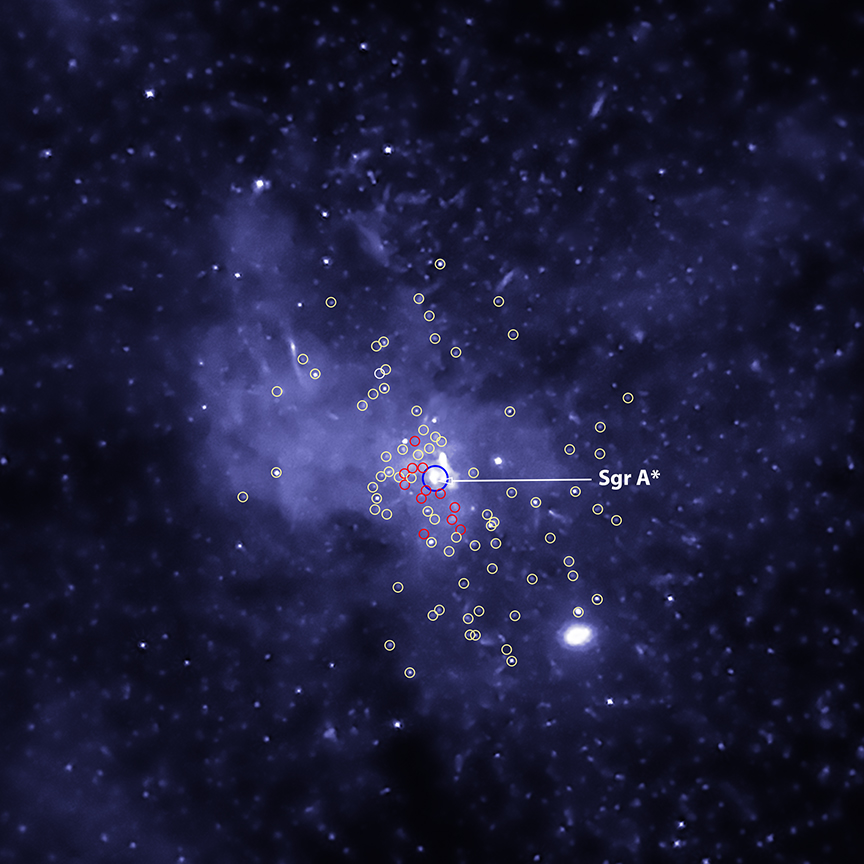
A recent informal poll found that astronomers don't yet have a good collective noun for a group of black holes, but they need one. The red circles in this Chandra Observatory X-ray image identify a group of a dozen black holes that are members of binary star systems. With 5 to 30 times the mass of the Sun, the black hole binaries are swarming within about 3 light-years of the center of our galaxy where the supermassive black hole identified as Sagittarius A* (Sgr A*) resides. Yellow circles indicate X-ray sources that are likely less massive neutron stars or white dwarf stars in binary star systems. Alone, black holes would be invisible, but as part of a binary star system they accrete material from their normal companion star and generate X-rays. At the distance of the galactic center Chandra can detect only the brighter of these black hole binary systems as point-like sources of X-rays, hinting that many fainter X-ray emitting black hole binaries should exist there, as yet undetected.