The Sun
The Sun is a yellow dwarf star (G2V), about 4.6 billion years old, and the dominant gravitational force in the Solar System. It has a diameter of roughly 1.4 million kilometers and contains around 99.8% of the Solar System’s mass. Nuclear fusion in its core converts hydrogen into helium, producing energy that warms the planets. Above the core lie the radiative and convective zones, followed by the visible photosphere (~5,500 °C), the chromosphere, and the much hotter corona (~2 million °C).
Source: science.nasa.gov
APODs including "The Sun"
Milky Way vs Airglow Australis
17/05/2018
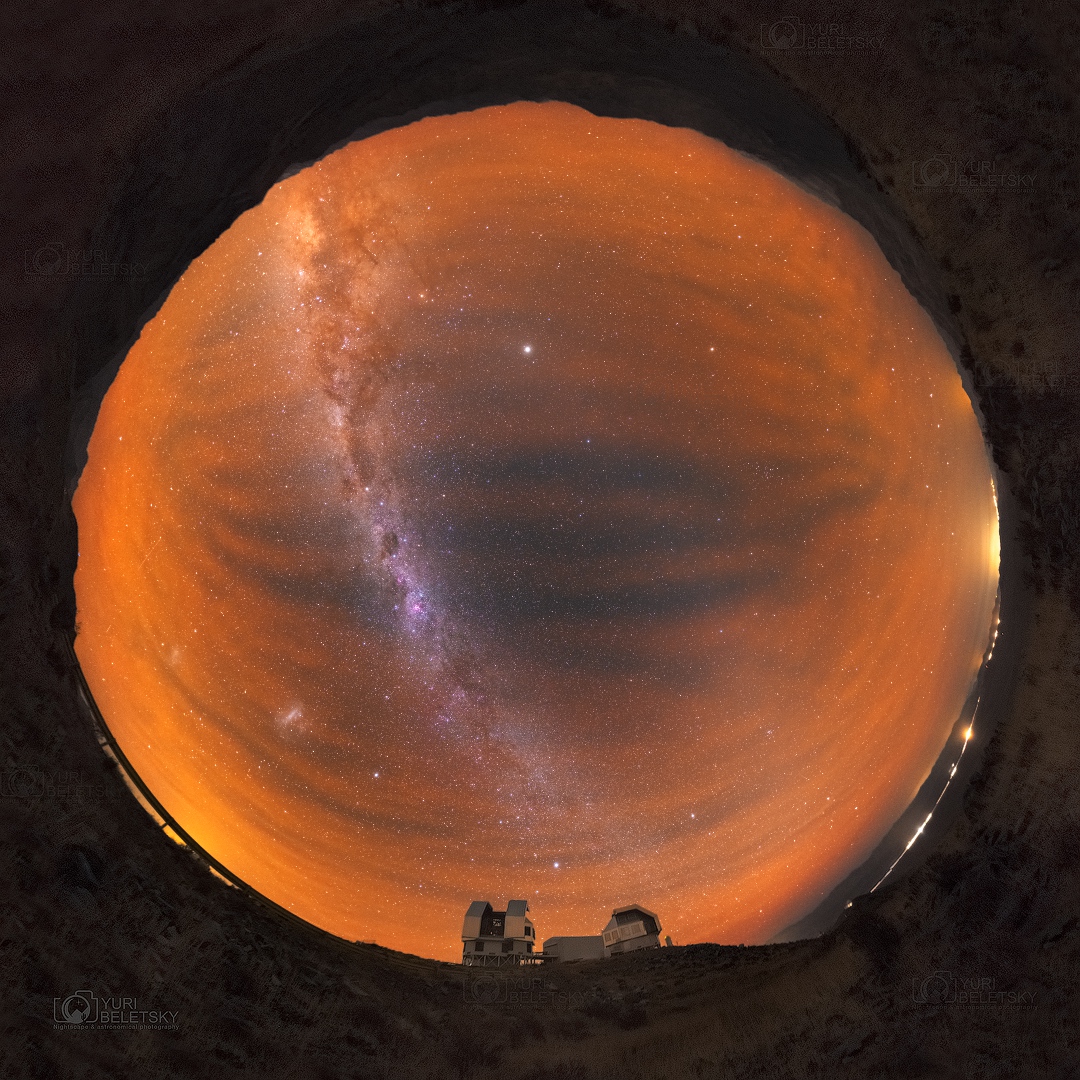
Captured last week after sunset on a Chilean autumn night, an exceptional airglow floods this allsky view from Las Campanas Observatory. The airglow was so intense it diminished parts of the Milky Way as it arced horizon to horizon above the high Atacama desert. Originating at an altitude similar to aurorae, the luminous airglow is due to chemiluminescence, the production of light through chemical excitation. Commonly recorded in color by sensitive digital cameras, the airglow emission here is fiery in appearance. It is predominately from atmospheric oxygen atoms at extremely low densities and has often been present during southern hemisphere nights over the last few years. Like the Milky Way, on that dark night the strong airglow was very visible to the eye, but seen without color. Jupiter is the brightest celestial beacon though, standing opposite the Sun and near the central bulge of the Milky Way rising above the eastern (top) horizon. The Large and Small Magellanic clouds both shine through the airglow to the lower left of the galactic plane, toward the southern horizon.