The Sun
The Sun is a yellow dwarf star (G2V), about 4.6 billion years old, and the dominant gravitational force in the Solar System. It has a diameter of roughly 1.4 million kilometers and contains around 99.8% of the Solar System’s mass. Nuclear fusion in its core converts hydrogen into helium, producing energy that warms the planets. Above the core lie the radiative and convective zones, followed by the visible photosphere (~5,500 °C), the chromosphere, and the much hotter corona (~2 million °C).
Source: science.nasa.gov
APODs including "The Sun"
Moon and Venus over Cannon Beach
17/07/2018
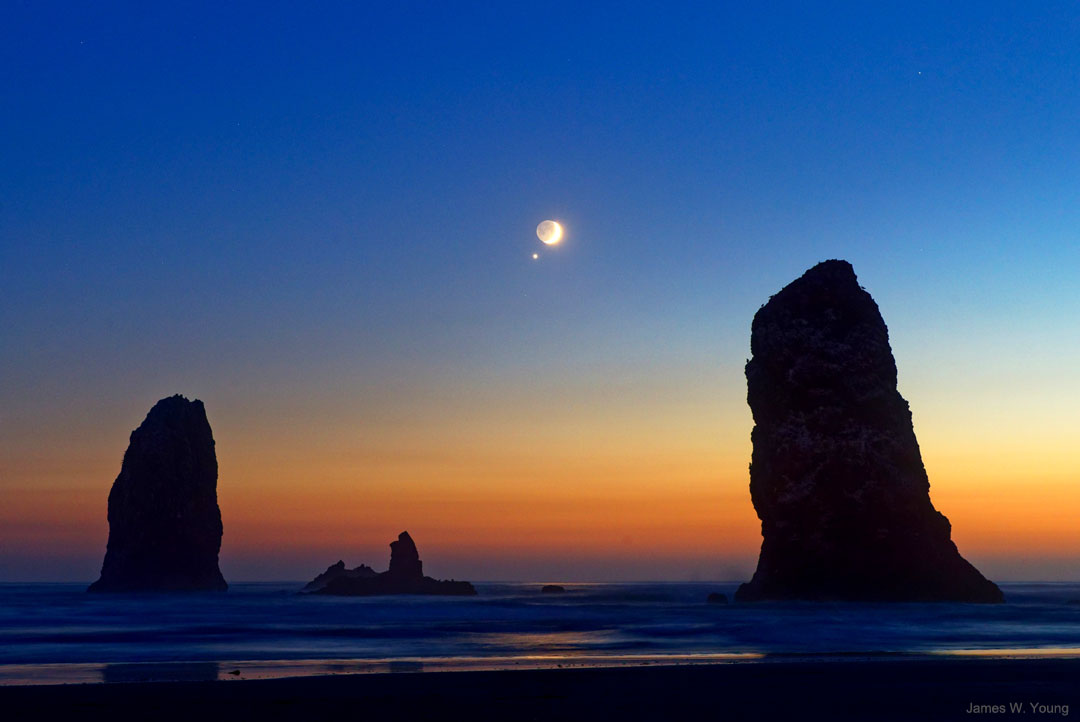
What's that spot next to the Moon? Venus. Two days ago, the crescent Moon slowly drifted past Venus, appearing within just one degree at its closest. This conjunction, though, was just one of several photographic adventures for our Moon this month (moon-th), because, for one, a partial solar eclipse occurred just a few days before, on July 12. Currently, the Moon appears to be brightening, as seen from the Earth, as the fraction of its face illuminated by the Sun continues to increase. In a few days, the Moon will appear more than half full, and therefore be in its gibbous phase. Next week the face of the Moon that always faces the Earth will become, as viewed from the Earth, completely illuminated by the Sun. Even this full phase will bring an adventure, though, as a total eclipse of this Thunder Moon will occur on July 27. Don't worry about our Luna getting tired, though, because she'll be new again next month (moon-th) -- August 11 to be exact -- just as she causes another partial eclipse of the Sun. Pictured, Venus and the Moon were captured from Cannon Beach above a rock formation off the Oregon (USA) coast known as the Needles. About an hour after this image was taken, the spin of the Earth caused both Venus and the Moon to set.