The Sun
The Sun is a yellow dwarf star (G2V), about 4.6 billion years old, and the dominant gravitational force in the Solar System. It has a diameter of roughly 1.4 million kilometers and contains around 99.8% of the Solar System’s mass. Nuclear fusion in its core converts hydrogen into helium, producing energy that warms the planets. Above the core lie the radiative and convective zones, followed by the visible photosphere (~5,500 °C), the chromosphere, and the much hotter corona (~2 million °C).
Source: science.nasa.gov
APODs including "The Sun"
Active Prominences on a Quiet Sun
20/08/2018
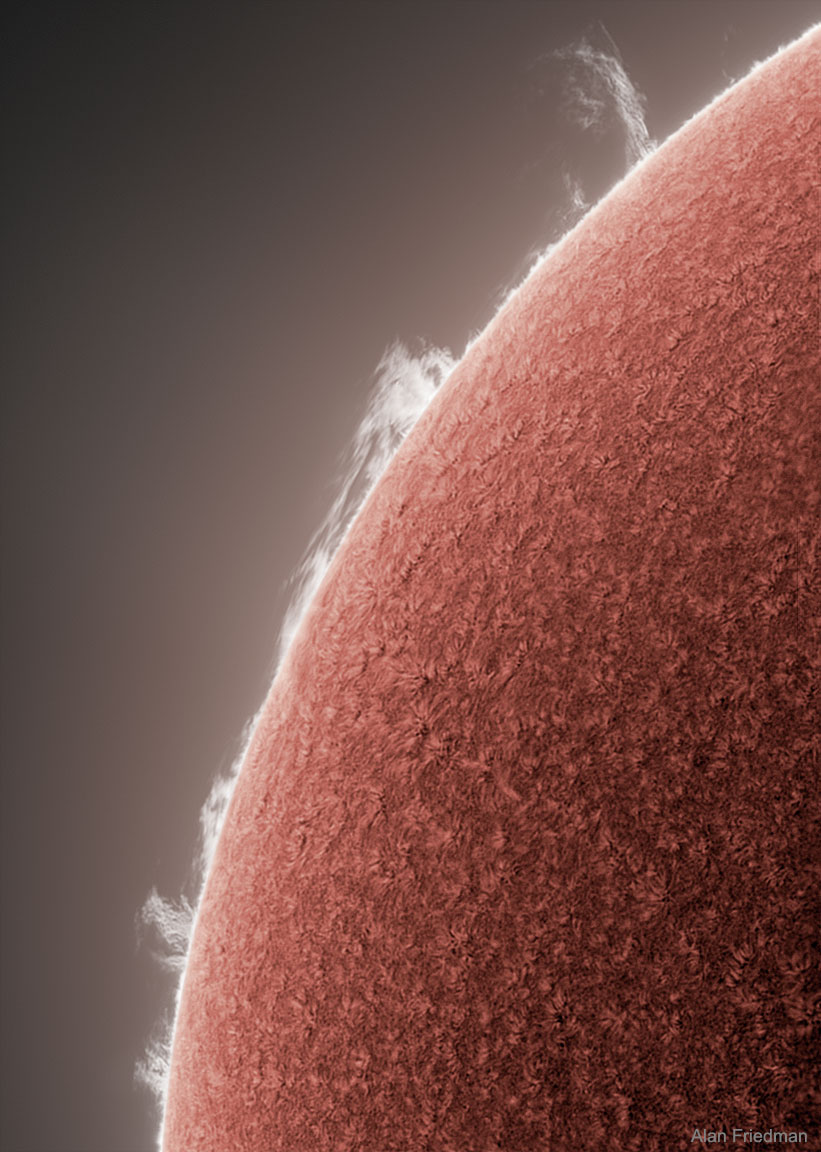
Why is the Sun so quiet? As the Sun enters into a period of time known as a Solar Minimum, it is, as expected, showing fewer sunspots and active regions than usual. The quietness is somewhat unsettling, though, as so far this year, most days show no sunspots at all. In contrast, from 2011 - 2015, during Solar Maximum, the Sun displayed spots just about every day. Maxima and minima occur on an 11-year cycle, with the last Solar Minimum being the most quiet in a century. Will this current Solar Minimum go even deeper? Even though the Sun's activity affects the Earth and its surroundings, no one knows for sure what the Sun will do next, and the physics behind the processes remain an active topic of research. The featured image was taken three weeks ago and shows that our Sun is busy even on a quiet day. Prominences of hot plasma, some larger than the Earth, dance continually and are most easily visible over the edge.