The Sun
The Sun is a yellow dwarf star (G2V), about 4.6 billion years old, and the dominant gravitational force in the Solar System. It has a diameter of roughly 1.4 million kilometers and contains around 99.8% of the Solar System’s mass. Nuclear fusion in its core converts hydrogen into helium, producing energy that warms the planets. Above the core lie the radiative and convective zones, followed by the visible photosphere (~5,500 °C), the chromosphere, and the much hotter corona (~2 million °C).
Source: science.nasa.gov
APODs including "The Sun"
Ice Halos at Yellowknife
14/09/2018
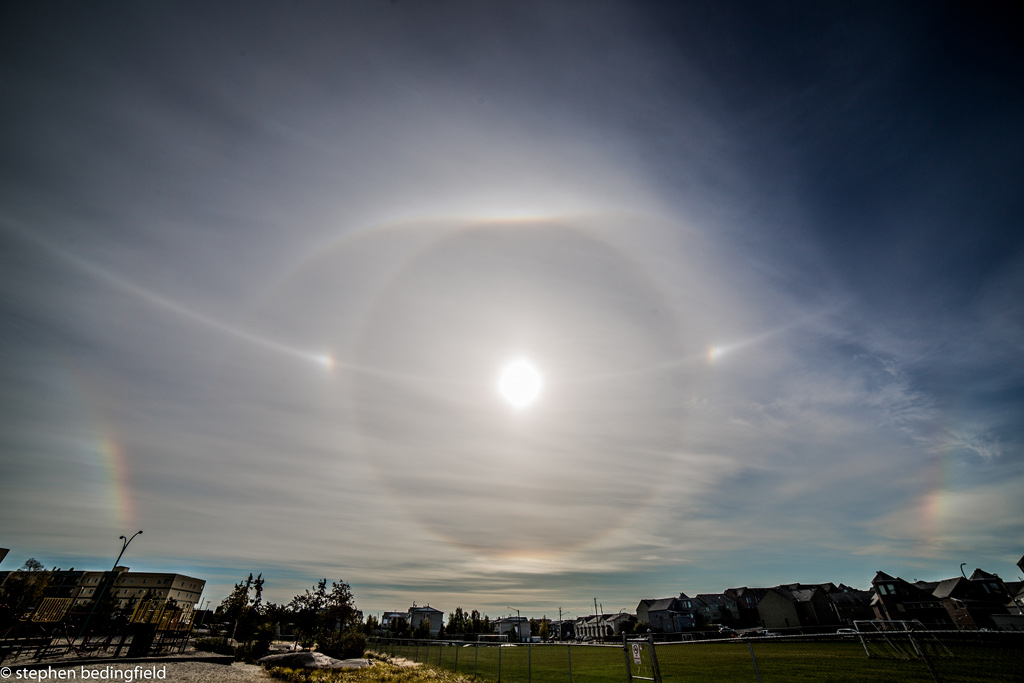
You've probably seen a circle around the Sun before. More common than rainbows, ice halos, like a 22 degree circular halo for example, can be easy to spot, especially if you can shade your eyes from direct sunlight. Still it's rare to see such a diverse range of ice halos, including sundogs, tangent, infralateral, and Parry arcs, all found in this snapshot from planet Earth. The picture was quickly taken in the late morning of September 4 from Yellowknife, Northwest Territories, Canada. The beautiful patterns are generated as sunlight (or moonlight) is reflected and refracted in six-sided water ice crystals in Earth's atmosphere. Of course, atmospheric ice halos in the skies of other worlds are likely to be different.