The Sun
The Sun is a yellow dwarf star (G2V), about 4.6 billion years old, and the dominant gravitational force in the Solar System. It has a diameter of roughly 1.4 million kilometers and contains around 99.8% of the Solar System’s mass. Nuclear fusion in its core converts hydrogen into helium, producing energy that warms the planets. Above the core lie the radiative and convective zones, followed by the visible photosphere (~5,500 °C), the chromosphere, and the much hotter corona (~2 million °C).
Source: science.nasa.gov
APODs including "The Sun"
Airglow Borealis
27/10/2018
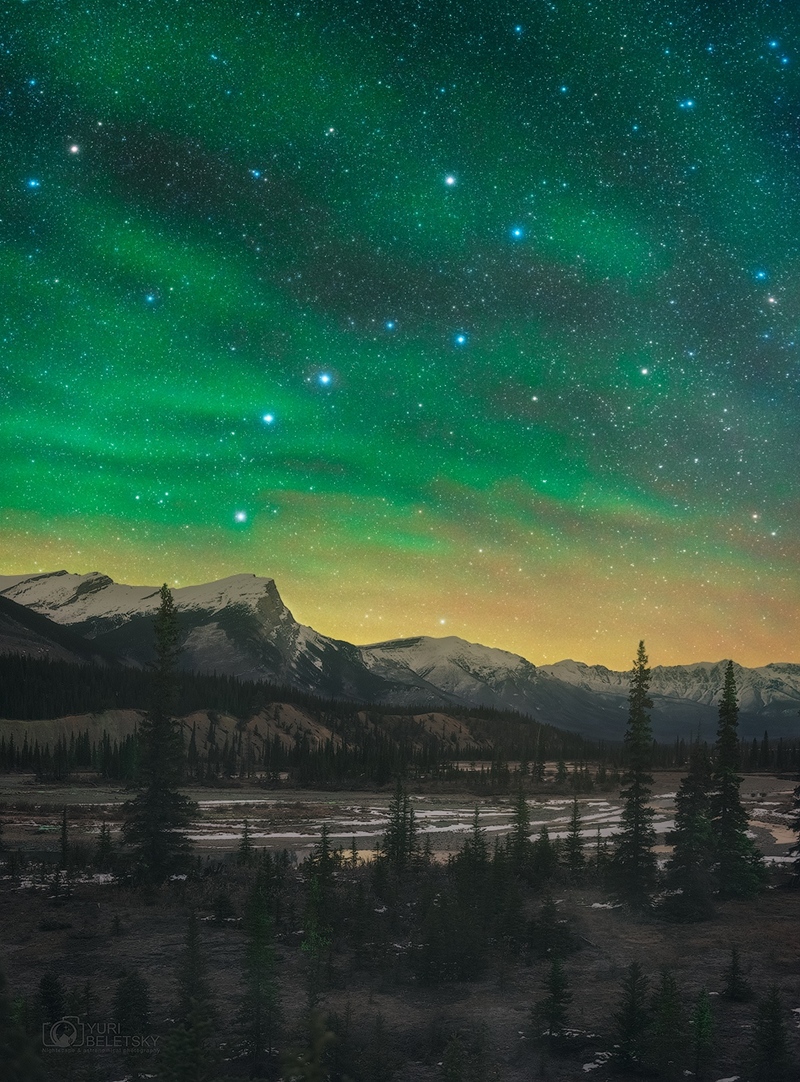
The best known asterism in northern skies hangs over the Canadian Rockies in this mountain and night skyscape taken last week from Banff National Park. But most remarkable is the amazing greenish airglow. With airglow visible to the eye, but not in color, the scene was captured in two exposures with a single camera, one exposure made while tracking the stars and one fixed to a tripod. Airglow emission is predominately from atmospheric oxygen atoms at extremely low densities. Commonly recorded in color by sensitive digital cameras the eerie, diffuse light is seen here in waves across the northern night. Originating at an altitude similar to aurorae, the luminous airglow is due to chemiluminescence, the production of light through chemical excitation and radiative decay. Energy for the chemical excitation is provided during daytime by the Sun's extreme ultraviolet radiation. Unlike aurorae which are limited to high latitudes, airglow can be found around the globe.