The Sun
The Sun is a yellow dwarf star (G2V), about 4.6 billion years old, and the dominant gravitational force in the Solar System. It has a diameter of roughly 1.4 million kilometers and contains around 99.8% of the Solar System’s mass. Nuclear fusion in its core converts hydrogen into helium, producing energy that warms the planets. Above the core lie the radiative and convective zones, followed by the visible photosphere (~5,500 °C), the chromosphere, and the much hotter corona (~2 million °C).
Source: science.nasa.gov
APODs including "The Sun"
The Hill, The Moon, and Saturn
16/11/2018
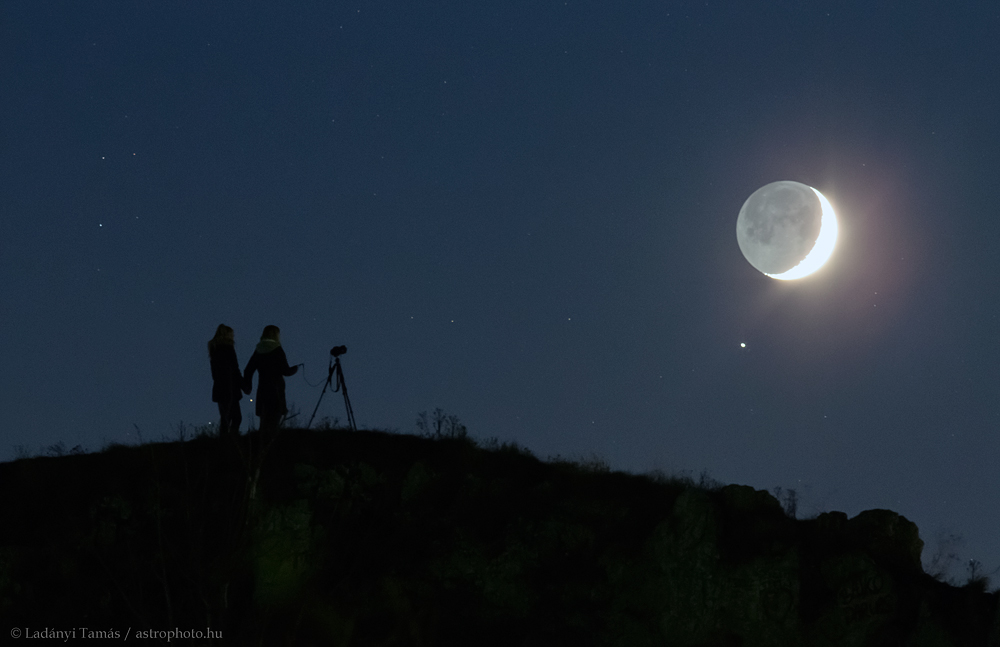
Last Sunday when the Moon was young its sunlit crescent hung low near the western horizon at sunset. With strong earthshine it was joined by Saturn shining in the early evening sky for a beautiful conjunction visible to skygazers around our fair planet. On that clear evening on a hill near Veszprem, Hungary mother, daughter, bright planet, and young Moon are framed in this quiet night skyscape taken with a telephoto lens. Of course the Moon ages too quickly for some, and by tonight the sunlit part has reached its first quarter phase. This weekend skygazers spending quality time under Moon and stars might expect to see the annual rain of comet dust otherwise known as the Leonid meteor shower. How to: Photograph the Leonid Meteor Shower