The Sun
The Sun is a yellow dwarf star (G2V), about 4.6 billion years old, and the dominant gravitational force in the Solar System. It has a diameter of roughly 1.4 million kilometers and contains around 99.8% of the Solar System’s mass. Nuclear fusion in its core converts hydrogen into helium, producing energy that warms the planets. Above the core lie the radiative and convective zones, followed by the visible photosphere (~5,500 °C), the chromosphere, and the much hotter corona (~2 million °C).
Source: science.nasa.gov
APODs including "The Sun"
New Horizons at Ultima Thule
29/12/2018
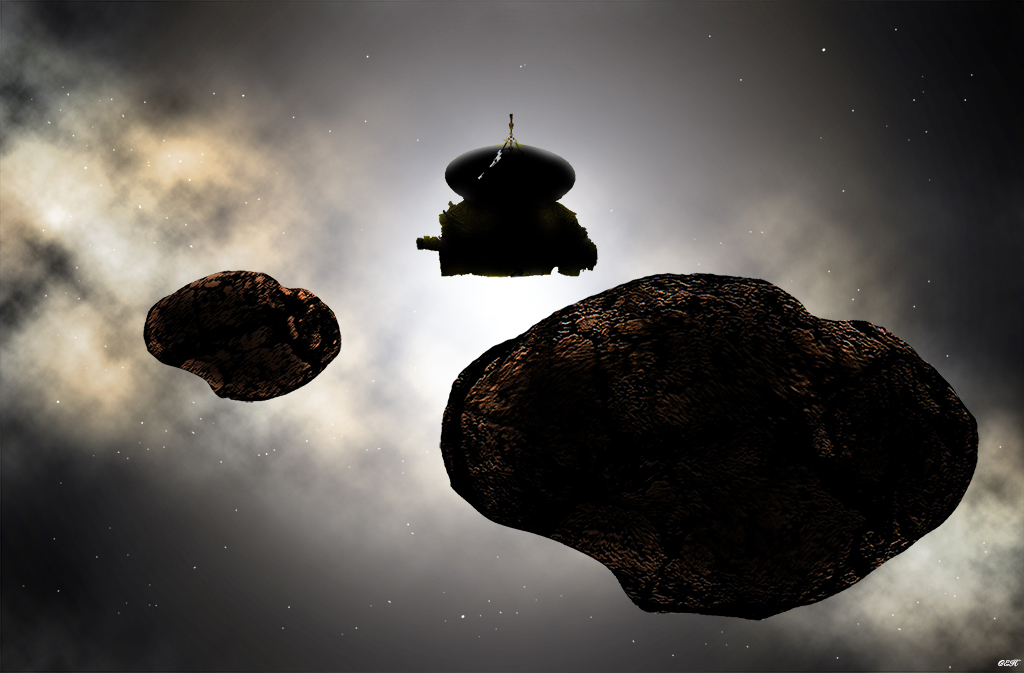
When we celebrate the start of 2019, on January 1 the New Horizons spacecraft will fly by Ultima Thule. A world of the Kuiper belt 6.5 billion kilometers from the Sun, the nickname Ultima Thule (catalog designation 2014 MU69) fittingly means "beyond the known world". Following its 2015 flyby of Pluto, New Horizons was targeted for this journey, attempting the most distant flyby for a spacecraft from Earth by approaching Ultima Thule to within about 3500 kilometers. The tiny world itself is about 30 kilometers in size. In 2017 and 2018, observing campaigns with Earth-based telescopes determined the shape of the object to be a contact binary or a close binary sytem as in this artist's illustration. New Horizons will image close up its unexplored surface in the dim light of the distant Sun.