The Sun
The Sun is a yellow dwarf star (G2V), about 4.6 billion years old, and the dominant gravitational force in the Solar System. It has a diameter of roughly 1.4 million kilometers and contains around 99.8% of the Solar System’s mass. Nuclear fusion in its core converts hydrogen into helium, producing energy that warms the planets. Above the core lie the radiative and convective zones, followed by the visible photosphere (~5,500 °C), the chromosphere, and the much hotter corona (~2 million °C).
Source: science.nasa.gov
APODs including "The Sun"
Ultima Thule Rotation Gif
04/01/2019
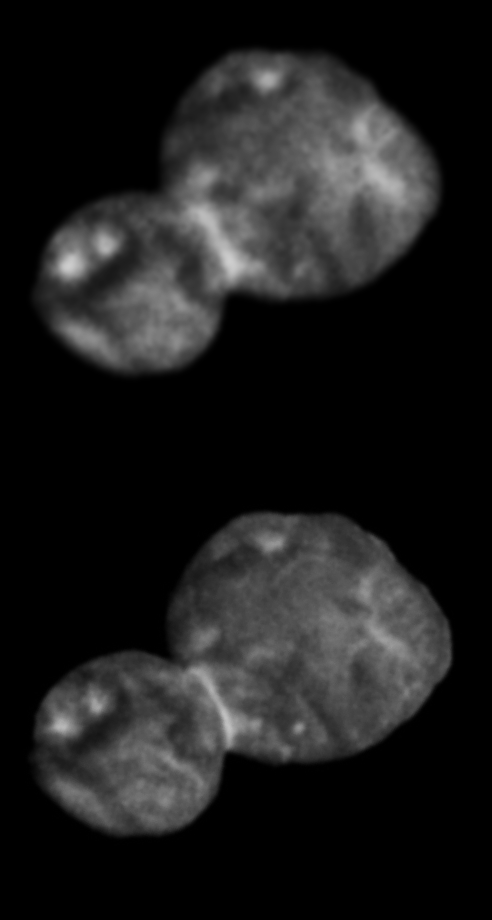
Ultima Thule is the most distant world explored by a spacecraft from Earth. In the dim light 6.5 billion kilometers from the Sun, the New Horizons spacecraft captured these two frames 38 minutes apart as it sped toward the Kuiper belt world on January 1 at 51,000 kilometers per hour. A contact binary, the two lobes of Ultima Thule rotate together once every 15 hours or so. Shown as a blinking gif, the rotation between the frames produces a tantalizing 3D perspective of the most primitive world ever seen. Dubbed separately by the science team Ultima and Thule, the larger lobe Ultima, is about 19 kilometers in diameter. Smaller Thule is 14 kilometers across.