The Sun
The Sun is a yellow dwarf star (G2V), about 4.6 billion years old, and the dominant gravitational force in the Solar System. It has a diameter of roughly 1.4 million kilometers and contains around 99.8% of the Solar System’s mass. Nuclear fusion in its core converts hydrogen into helium, producing energy that warms the planets. Above the core lie the radiative and convective zones, followed by the visible photosphere (~5,500 °C), the chromosphere, and the much hotter corona (~2 million °C).
Source: science.nasa.gov
APODs including "The Sun"
Partial Eclipse over Beijing
11/01/2019
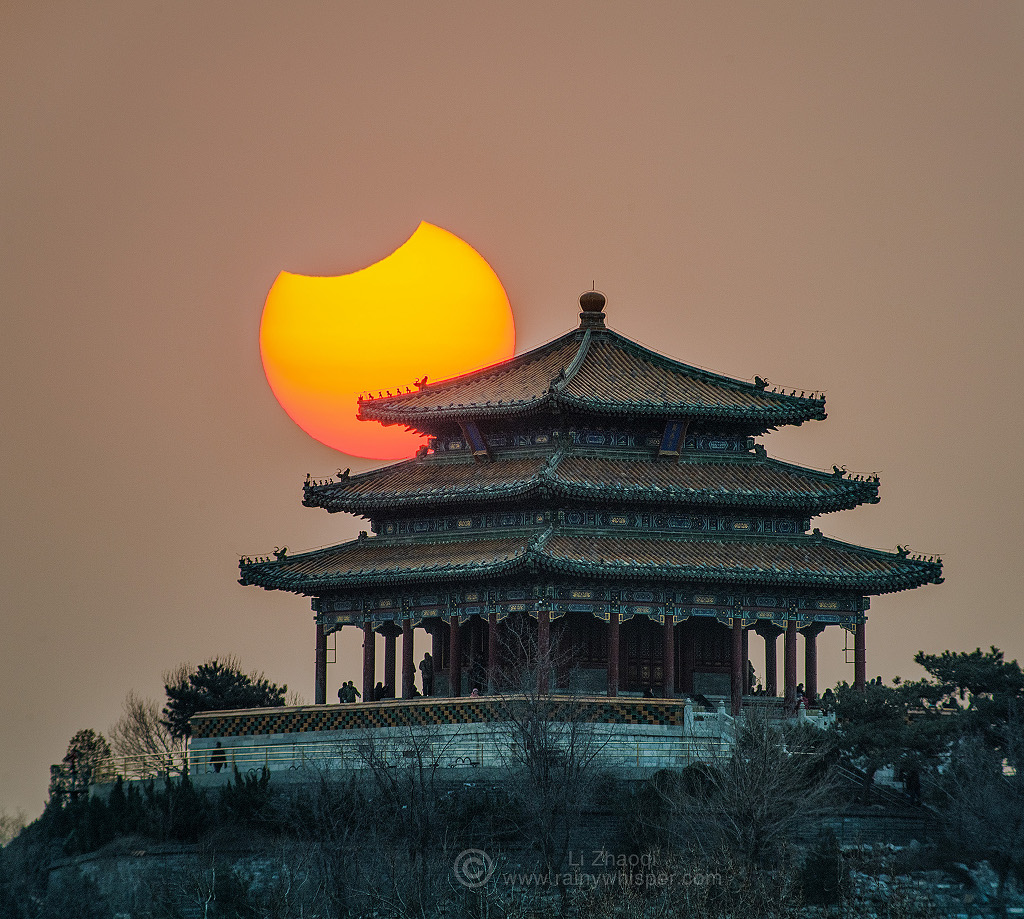
On January 6 the New Moon rose in silhouette with the Sun seen from northeastern Asia. Near maximum, the dramatic partial solar eclipse is captured in this telephoto view through hazy skies. In the foreground, the hill top Wanchun pavilion overlooking central Beijing's popular Forbidden City hosts eclipse-watching early morning risers. This was the first of five, three solar and two lunar, eclipses for 2019. Next up is a total lunar eclipse during this month's Full Perigee Moon. At night on January 21, that celestial shadow play will be visible from the hemisphere of planet Earth that includes the Americas, Europe, and western Africa.