The Sun
The Sun is a yellow dwarf star (G2V), about 4.6 billion years old, and the dominant gravitational force in the Solar System. It has a diameter of roughly 1.4 million kilometers and contains around 99.8% of the Solar System’s mass. Nuclear fusion in its core converts hydrogen into helium, producing energy that warms the planets. Above the core lie the radiative and convective zones, followed by the visible photosphere (~5,500 °C), the chromosphere, and the much hotter corona (~2 million °C).
Source: science.nasa.gov
APODs including "The Sun"
Wide Field View of Great American Eclipse
30/01/2019
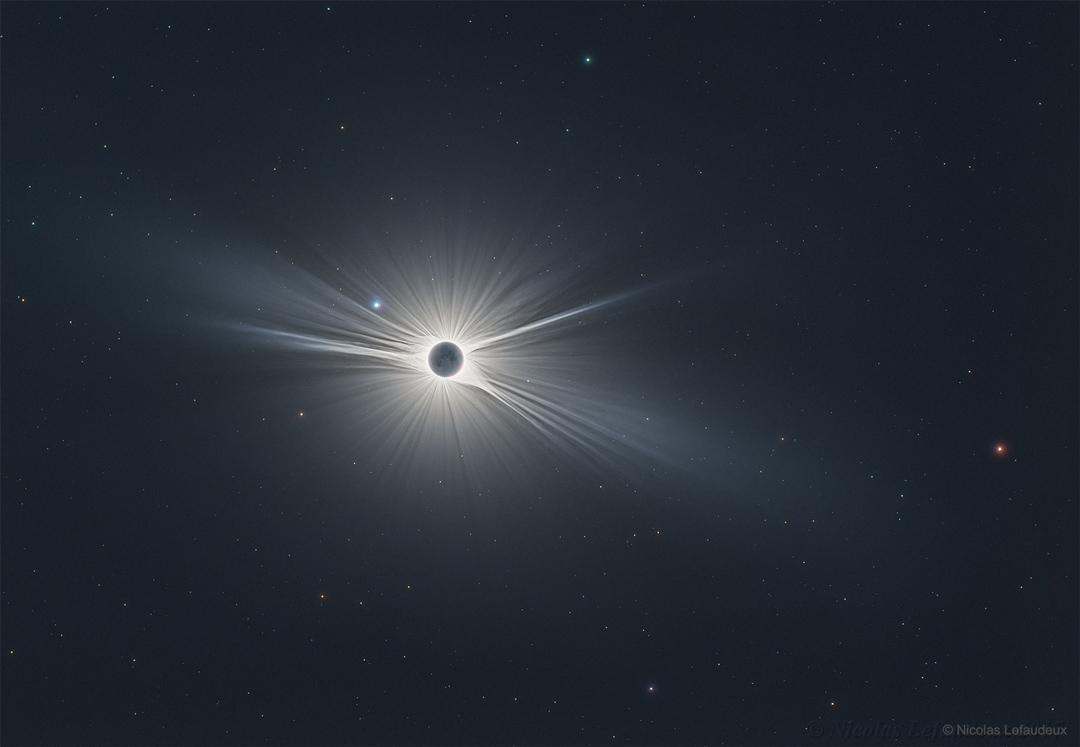
Only in the fleeting darkness of a total solar eclipse is the light of the solar corona easily visible. Normally overwhelmed by the bright solar disk, the expansive corona, the sun's outer atmosphere, is an alluring sight. But the subtle details and extreme ranges in the corona's brightness, although discernible to the eye, are notoriously difficult to photograph. Pictured here, however, using over 120 images and meticulous digital processing, is a detailed wide-angle image of the Sun's corona taken during the Great American Eclipse in 2017 August. Clearly visible are intricate layers and glowing caustics of an ever changing mixture of hot gas and magnetic fields. Hundreds of stars as faint as 11th magnitude are visible behind the Moon and Sun, with Mars appearing in red on the far right. The next total eclipse of the Sun will occur on July 2 and be visible during sunset from a thin swath across Chile and Argentina.