The Sun
The Sun is a yellow dwarf star (G2V), about 4.6 billion years old, and the dominant gravitational force in the Solar System. It has a diameter of roughly 1.4 million kilometers and contains around 99.8% of the Solar System’s mass. Nuclear fusion in its core converts hydrogen into helium, producing energy that warms the planets. Above the core lie the radiative and convective zones, followed by the visible photosphere (~5,500 °C), the chromosphere, and the much hotter corona (~2 million °C).
Source: science.nasa.gov
APODs including "The Sun"
Shadow of a Martian Robot
17/02/2019
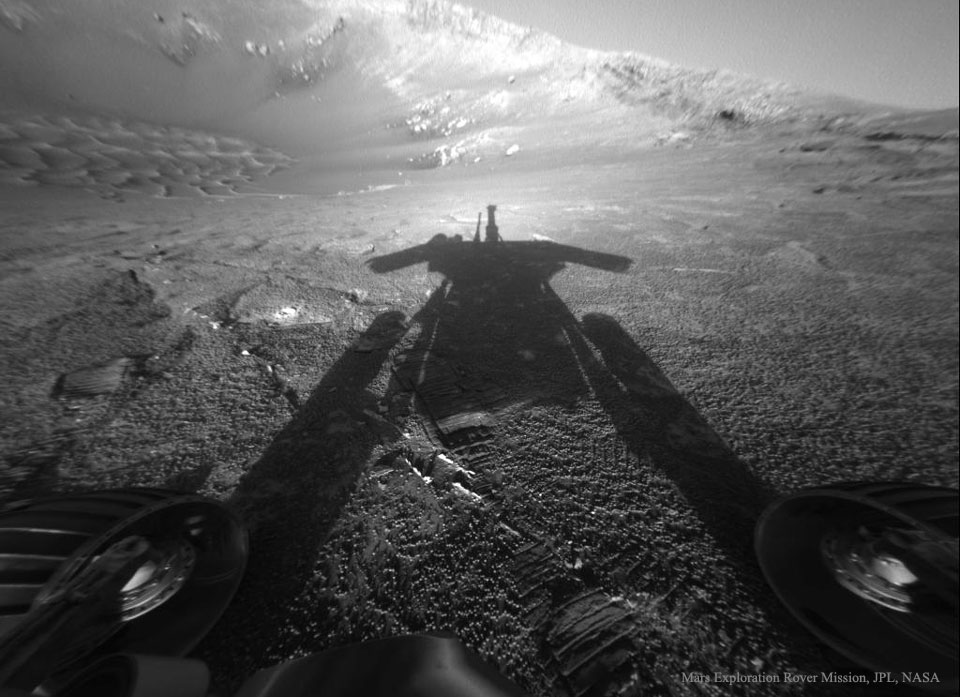
What if you saw your shadow on Mars and it wasn't human? Then you might have been the Opportunity rover exploring Mars. Opportunity explored the red planet from 2004 to 2018, finding evidence of ancient water, and sending breathtaking images across the inner Solar System. Pictured here in 2004, Opportunity looks opposite the Sun into Endurance Crater and sees its own shadow. Two wheels are visible on the lower left and right, while the floor and walls of the unusual crater are visible in the background. Caught in a dust storm in 2018, last week NASA stopped trying to contact Opportunity and declared the ground-breaking mission, originally planned for only 92 days, complete.