The Sun
The Sun is a yellow dwarf star (G2V), about 4.6 billion years old, and the dominant gravitational force in the Solar System. It has a diameter of roughly 1.4 million kilometers and contains around 99.8% of the Solar System’s mass. Nuclear fusion in its core converts hydrogen into helium, producing energy that warms the planets. Above the core lie the radiative and convective zones, followed by the visible photosphere (~5,500 °C), the chromosphere, and the much hotter corona (~2 million °C).
Source: science.nasa.gov
APODs including "The Sun"
ISS from Wallasey
06/04/2019
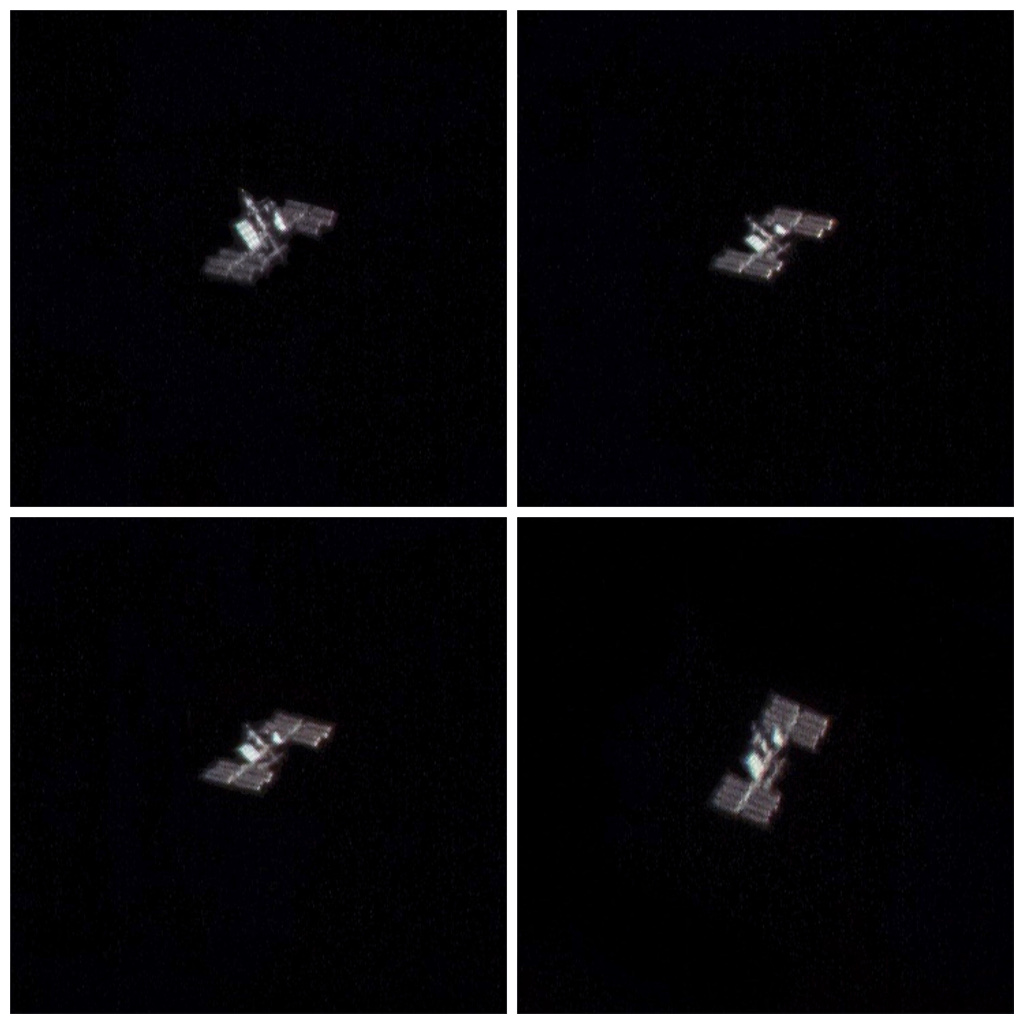
After sunset on March 28, the International Space Station climbed above the western horizon, as seen from Wallasey, England at the mouth of the River Mersey. Still glinting in the sunlight some 400 kilometers above planet Earth, the fast moving ISS was followed by hand with a small backyard telescope and high frame rate digital camera. A total of 2500 frames were recorded during the 7 minute long visible ISS passage and 100 of them captured images of the space station. These are the four best frames showing remarkable details of the ISS in low Earth orbit. Near the peak of its track, about 60 degrees above the horizon, the ISS was brighter than the brightest star in the sky and as close as 468 kilometers to the Wallasey backyard.