The Sun
The Sun is a yellow dwarf star (G2V), about 4.6 billion years old, and the dominant gravitational force in the Solar System. It has a diameter of roughly 1.4 million kilometers and contains around 99.8% of the Solar System’s mass. Nuclear fusion in its core converts hydrogen into helium, producing energy that warms the planets. Above the core lie the radiative and convective zones, followed by the visible photosphere (~5,500 °C), the chromosphere, and the much hotter corona (~2 million °C).
Source: science.nasa.gov
APODs including "The Sun"
Rigil Kentaurus and Sandqvist 169
13/04/2019
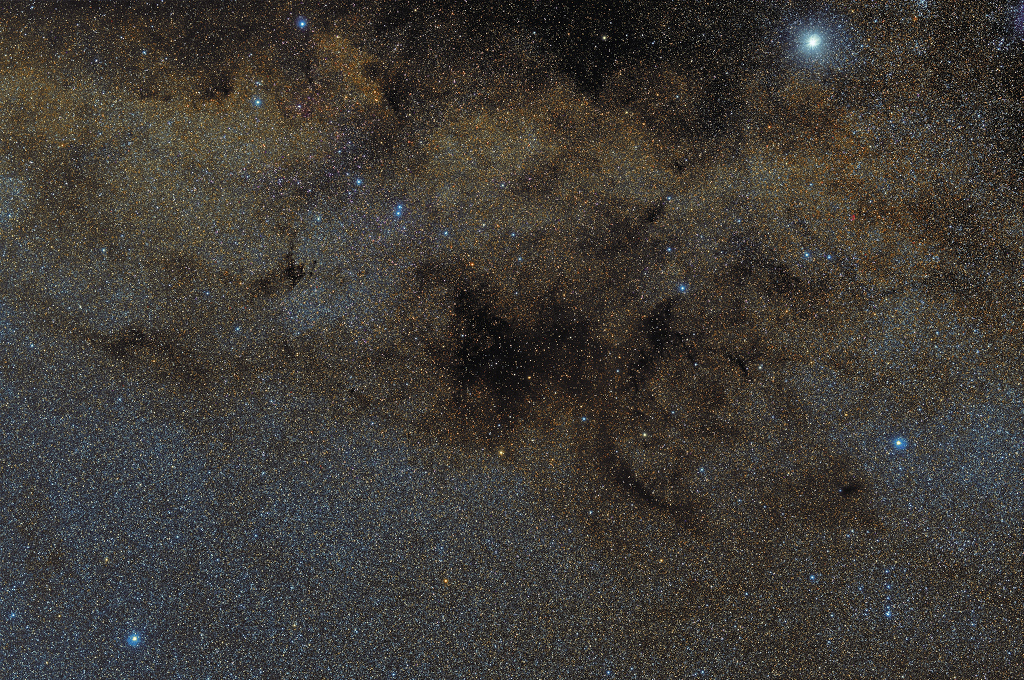
Rigil Kentaurus is the bright star near the top of this broad southern skyscape. Of course it's probably better known as Alpha Centauri, nearest star system to the Sun. Below it sprawls a dark nebula complex. The obscuring interstellar dust clouds include Sandqvist catalog clouds 169 and 172 in silhouette against the rich starfields along the southern Milky Way. Rigil Kent is a mere 4.37 light-years away, but the dusty dark nebulae lie at the edge of the starforming Circinus-West molecular cloud about 2,500 light-years distant. The wide-field of view spans over 12 degrees (24 full moons) across southern skies.